AI Study Assistant: Master Your Coursework
ai study assistantstudy toolsexam prepstudent productivityai learning
12 min read

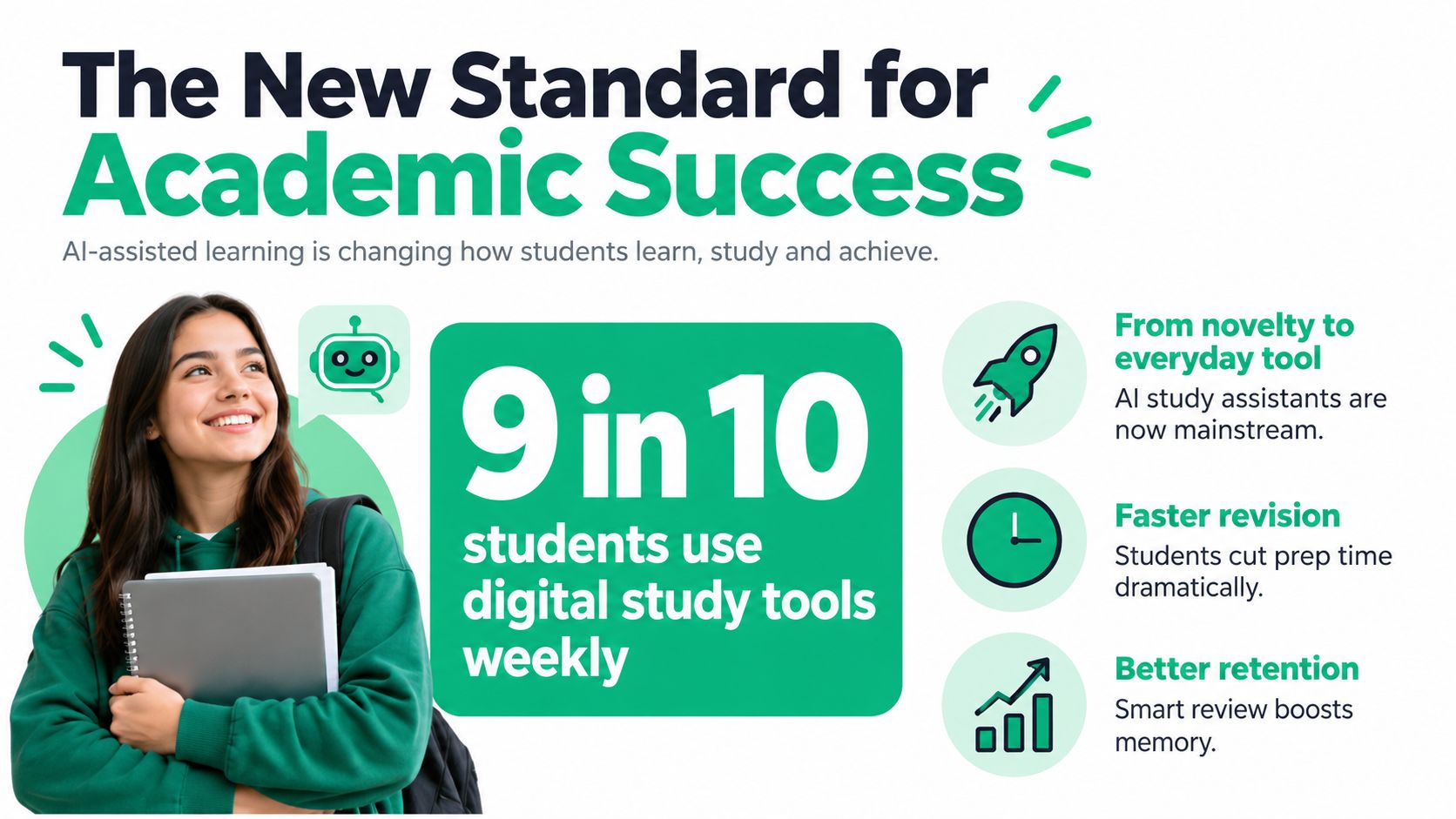
In the UK, 95% of full-time undergraduates said they used AI in at least one way in 2026, up from 92% in 2025 and 66% in 2024. That's not a fringe habit anymore, it's a new study habit, and 94% said they used generative AI to help with assessed work in the same survey (HEPI 2026 survey). The question isn't whether students should use an AI study assistant. It's whether they're using one that helps them remember more, think harder, and stay academically honest.
A useful AI study assistant does more than rewrite notes. It can quiz you, space out reviews, turn reading into audio, flag weak spots, and help you move from passive scrolling to active recall. Used well, it becomes a learning system, not a shortcut.
The shift from experiment to routine is already visible in student behavior. A 2026 report found that 61% of students used AI at least weekly, up from 42% the year before, and the top uses included writing and editing assignments, tutoring, and notetaking or summarizing lectures (HEPI 2026 survey). That matters because it shows AI has moved into the everyday rhythm of studying, not just the edges of it.
A generic chatbot answers whatever you ask. A true AI study assistant helps you decide what to study next, when to revisit it, and how to check whether you learned it. That difference is huge, because learning is not just about producing text. It's about building memory, confidence, and transfer under pressure.
Practical rule: if a tool only helps you finish a task faster, it's probably a helper. If it helps you remember, self-test, and review with intention, it's acting like a study assistant.
The history of this idea goes back much further than the current hype. Educational AI systems have existed since the 1960s, and the modern acceleration began after the public release of ChatGPT on November 30, 2022, followed by Khan Academy's Khanmigo in March 2023 and UNESCO's guidance on generative AI in education in September 2023 (history overview). By 2025, higher education had its own dedicated category with ChatGPT Edu for universities and colleges. The pattern is clear, the tool has matured from novelty into infrastructure.
For students, that means the right mindset is no longer “Can AI help me write this?” It's “How can AI help me study this in a way I'll still know next week?” That's the standard worth aiming for.
The best study assistants don't behave like digital crammers. They behave more like a coach who knows when you're about to forget something and taps you on the shoulder just in time. That timing matters because spaced retrieval practice is one of the strongest learning mechanisms available, and it works better than packing all your review into one long session (Purdue review).
When you answer from memory, your brain does more work than when you just recognize the answer on a page. That effort is useful. In the Purdue-reviewed experiment, increasing the spacing between repeated tests produced a 200% improvement in long-term retention relative to repeated retrieval with no spacing, and a meta-analytic review found a strong benefit of spaced retrieval over massed retrieval, with no meaningful difference between expanding and uniform spacing schedules. In plain terms, the timing of review matters as much as the content.
That's why a good assistant shouldn't just summarize your notes. It should turn them into flashcards, quiz prompts, and scheduled review sessions. The assistant is less like a copier and more like a librarian who keeps re-shelving the hardest books right before you'd lose them.
An AI tutor can watch how you perform on questions and adjust the next prompt. If you keep missing one physiology pathway or one economics concept, the system can bring it back sooner. That makes the tool useful in a way static notes never can, because the review path changes with your memory, not with a fixed syllabus.
Audio adds another layer when you use it carefully. Research on spoken instruction found that compressed auditory delivery up to 1.5× did not significantly reduce attention, cognitive load, or learning performance compared with normal speed, while 3.0× speed lowered comprehension and raised cognitive load (audio pacing study). So if your assistant generates narrated lessons, the smart move is moderate pacing, not sprint mode.
If distraction is part of your problem, it helps to pair study support with guardrails outside the lesson itself. For students who need stronger boundaries around apps and focus time, a resource like ADHD-friendly app blocking features can make the rest of the workflow more usable.
A student in a lecture-heavy course usually doesn't need more information. They need a better format. That's where an AI study assistant becomes practical, because it can transform the same material into formats your brain can readily digest on the move, at your desk, or during a quick review break.
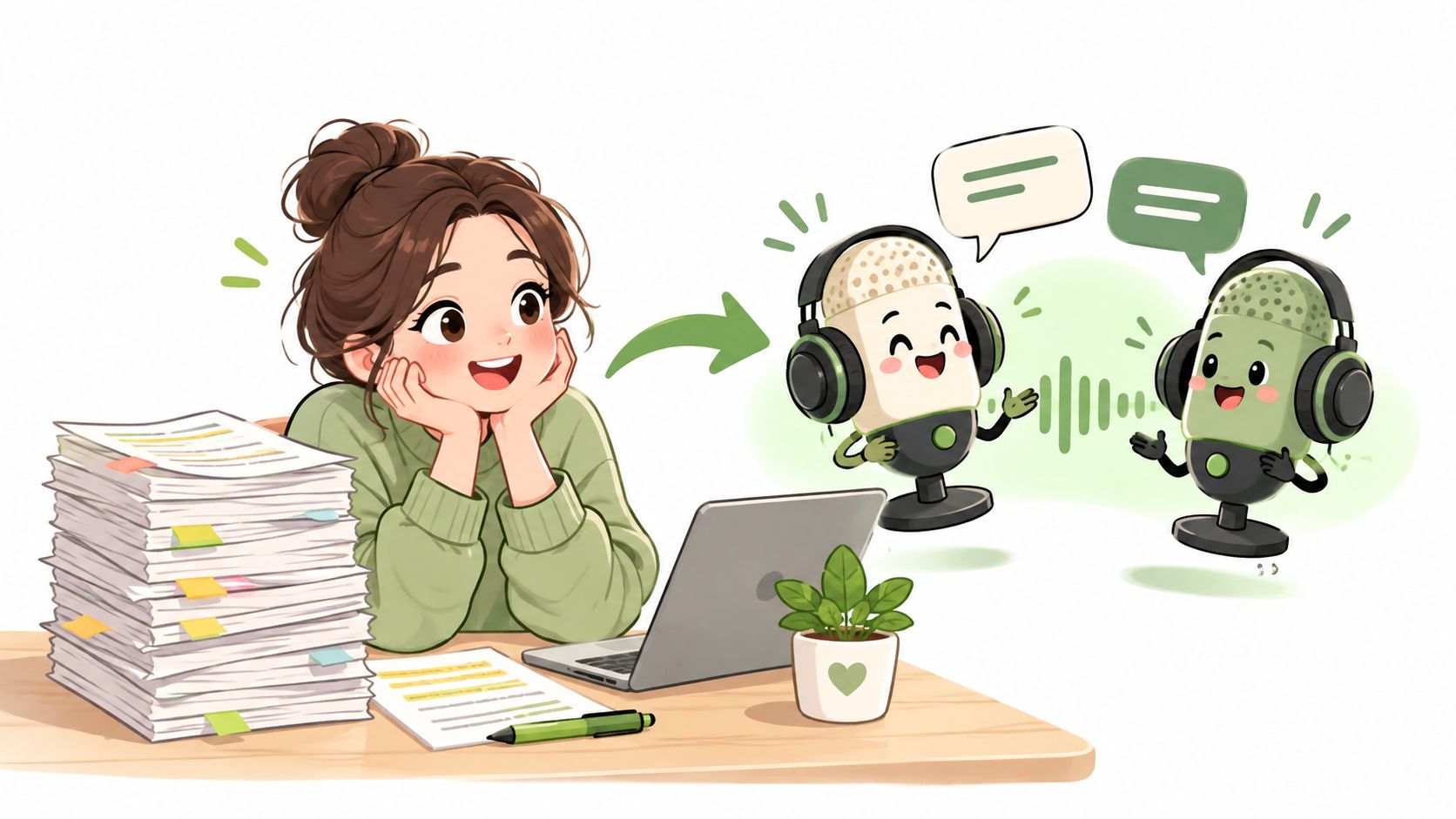
A common workflow starts with messy inputs. You feed in lecture notes, PDFs, or chapter excerpts, then ask the assistant to pull out the key ideas, define terms in plain language, and generate quiz questions. That's useful on its own, but the bigger win comes when those same materials get reshaped into an audio digest you can listen to on a commute or while walking between classes.
For example, a student in biology can turn dense lecture slides into a two-host audio review, one voice asking questions and the other explaining the answer. A history student can turn scattered reading notes into a timeline recap with dates, causes, and consequences spoken out loud. A law student can turn a case brief into short prompts that test issue, rule, application, and conclusion without staring at a screen for another hour.
The point isn't to consume more content. The point is to give the same content a second route into memory.
Later in the week, the assistant can switch from explanation to testing. It can generate a mock exam, then reorder the questions based on what you missed. If you're studying a subject with a lot of terminology, that format is especially helpful because it forces recall instead of passive recognition.
For students trying to keep distraction under control while they study, a focused planning tool like the focus app for university students can sit neatly alongside an AI assistant. One handles the material, the other helps protect the time you've set aside for it.
One of the clearest uses is when your reading pile is fragmented. Instead of hopping between PDFs, notes, and lecture slides, you can ask the assistant to unify them into one study guide. That's especially helpful before exams, when your biggest problem is usually not intelligence but organization.
Students who like structured methods can combine that with a more personalized study philosophy, like the Ace Med Boards study approach, where the emphasis is on adapting the method to the learner instead of forcing the learner into a rigid template. That principle fits AI study tools well, because the best workflows are built around your course load, your commute, and your attention span.
Not every AI shortcut is a smart academic move. A tool can make you faster while making you less independent, and that's the trap many students fall into. If the assistant does the thinking for you too often, you can end up with polished output and weak recall.
That concern is not hypothetical. An artefactual field experiment with 334 students found that AI tutor access improved incentivized assessment performance by 0.23 standard deviations overall, but the biggest gains came from unrestricted access (0.34 SD) rather than restricted access (0.21 SD) (field experiment). The broader lesson is simple, rigid limits can blunt learning, but blanket dependence can still weaken judgment. Better design matters.
Use AI to clarify, quiz, summarize, and reorganize. Be careful when it starts drafting assessed work in a way that replaces your own understanding. That distinction matters because students already use AI heavily for study, and the boundary between assistance and substitution is still shifting.
A useful personal code is this:
The danger isn't only academic misconduct. It's the illusion of competence. You read a polished summary, nod along, and assume the material is in your head. Then exam day arrives, and the memory isn't there.
There's also a cognitive cost to overly narrow systems. A recent synthesis reported a large positive overall effect on learning outcomes, but it also noted heterogeneity, which means different AI workflows don't produce the same result. That's why the smartest students use AI as scaffolding, not as a replacement for effort.
The internal rule I'd give any student is blunt. If you can't explain the answer without opening the assistant, you haven't learned it yet.
The strongest workflow is simple enough to repeat every week and flexible enough to handle real academic chaos. Start by collecting your material in one place, then use the assistant to turn that material into something active, audible, and reviewable. A service like Rooy Development fits naturally here because it creates personalized podcast episodes from user-selected sources, including PDFs, notes, websites, and YouTube channels, which makes it useful for converting study material into recurring audio reviews.
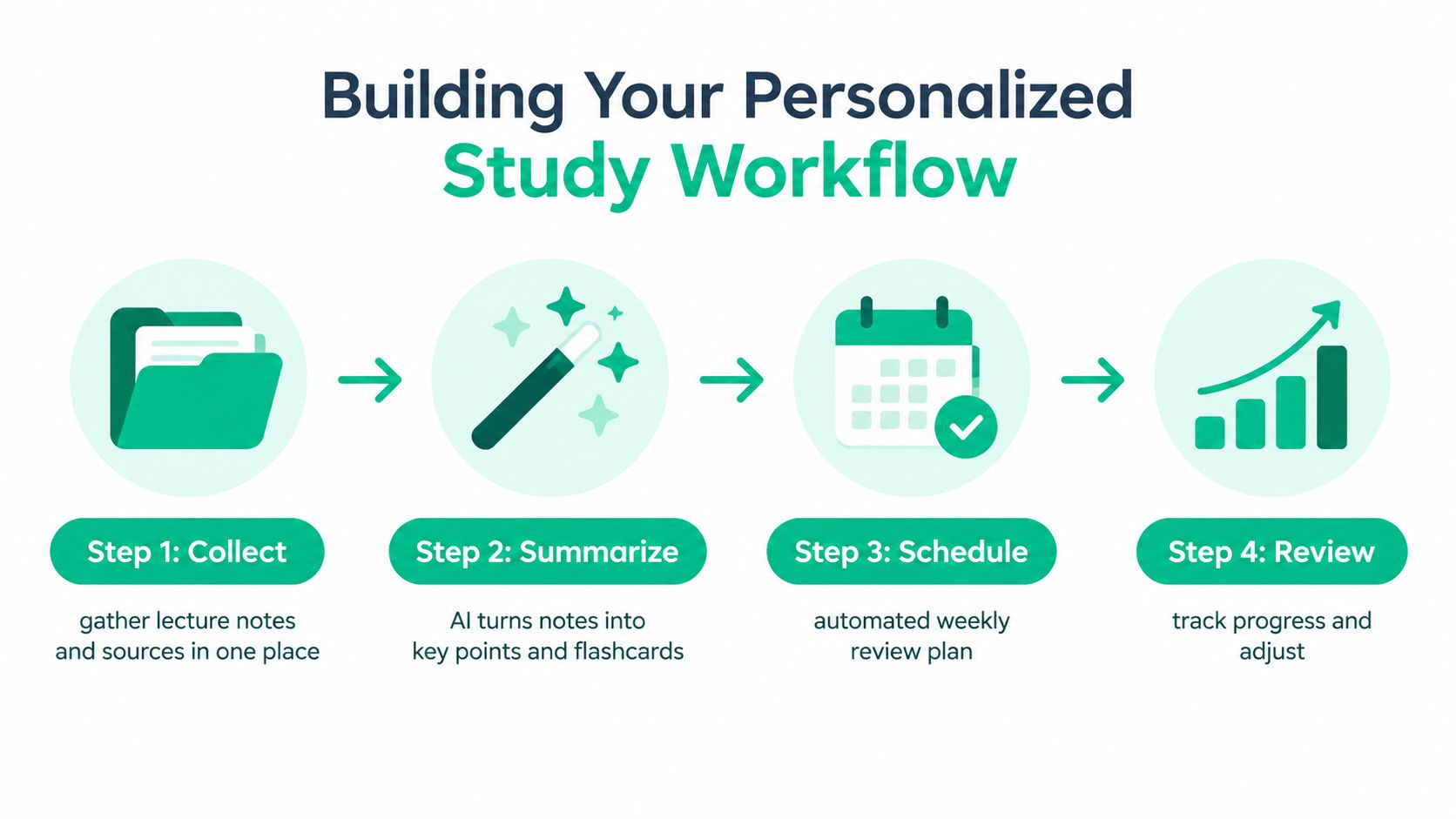
First, gather your lecture notes, slides, readings, and any messy margin notes into one folder. Second, ask the assistant to summarize them into key points, definitions, and flashcards. Third, schedule review based on when you're most likely to forget the topic, not just when you happen to have time.
The fourth step is where the system becomes real. Review with active recall, then use the misses to reshape the next session. That loop makes the assistant feel less like a tool you consult once and more like a learning partner that follows the shape of your semester.
A simple weekly rhythm works well here:
What students usually get wrong is trying to do too much in one sitting. Audio helps, but it shouldn't become another form of passive consumption. Keep segments short, then follow each one with a question or prompt that forces you to retrieve the idea on your own.
For students who want a more personalized structure around attention and study habits, the how to focus while studying guide is a useful companion, especially if you're building a routine that has to survive distractions, deadlines, and competing classes. The goal is consistency, not intensity.
An AI study assistant is most valuable when it helps you think longer, not just type faster. The strongest workflows use the tool to reshape reading into recall, audio, and review, so the learning sticks after the assignment is turned in. That's the difference between finishing schoolwork and mastering coursework.
Before your next study session, check three things. First, are you using AI to understand or just to produce? Second, are you testing yourself often enough to catch weak spots? Third, are you mixing reading, listening, and retrieval so the material has more than one path into memory?
If you answer yes to the first two and no to the third, start with one change this week. Turn one lecture or reading set into an audio recap, then pair it with a short quiz. That small shift often does more for retention than another hour of rereading ever will.
Rooy Development builds the kind of AI podcast generator that turns notes, PDFs, websites, and YouTube sources into personalized audio episodes, which fits naturally into a modern study workflow. If you want to explore a tool that can support audio-based revision and recurring learning routines, visit Rooy Development and see how it can fit your coursework.
Transform your content into engaging podcasts in seconds with our AI-powered platform.
Get Started Now