
AI Powered Podcast: How It Works and Where It's Going
ai powered podcastai podcast generatorsynthetic voicepersonalized audiopodcast automation
16 min read
You're halfway through a commute, skipping past generic headlines, recycled interviews, and yesterday's news. Then a new episode appears about a competitor's pricing change, built from the articles you saved, narrated in a familiar voice, and ready before your coffee cooled. It feels less like choosing a show and more like opening a briefing prepared for exactly this morning.
That's the promise of an AI powered podcast. Software can gather source material, decide what matters, draft a conversation, generate speech, and deliver an MP3 or private feed on a schedule. The result can be useful and surprisingly natural, but it also raises practical questions: where did the claims come from, what still sounds artificial, and which listening jobs are better served by a human production team?
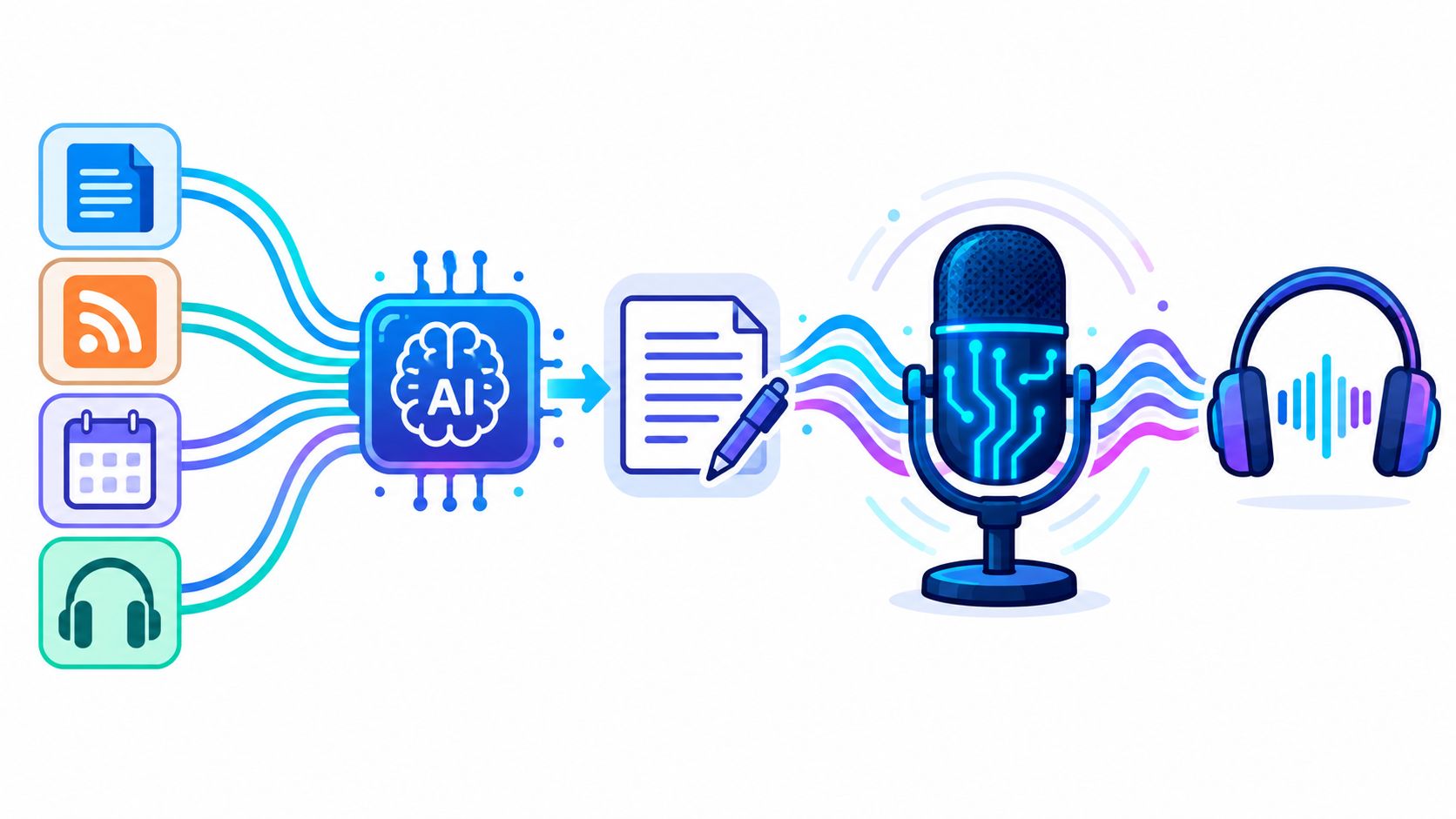
An AI powered podcast is an episode assembled largely or entirely by software for a particular listening purpose. The system may start with saved articles, RSS feeds, internal documents, calendars, email, PDFs, notes, or videos. It then selects material, creates an editorial outline, writes narration or dialogue, renders voices, and publishes the finished audio.
That definition separates several formats that are often mixed together:
The most interesting version is personalized audio. One listener might receive a short technology briefing based on saved articles, while another gets a study episode built from lecture notes. A producer can also use the same machinery to accelerate research-heavy shows while keeping human approval in the loop.
A useful distinction: The input can be real and traceable even when the host is synthetic. The automation changes the route from source to listener, not necessarily the origin of the information.
A two-host conversation often makes dense material easier to follow because one voice can explain while the other asks for clarification. If you want to understand the human side of podcast production before experimenting with synthetic hosts, resources such as becoming a guest on the Nvidia AI Podcast provide helpful context about how traditional shows are created and presented.
The listener still needs to know what the episode is. Is it a summary, an interpretation, a language conversion, or a fictional discussion? Clear labeling matters because a smooth voice can make a generated script feel more authoritative than its source material deserves.
Think of the production line as a kitchen. The sources are the ingredients, curation chooses the recipe, scripting writes the instructions, voice synthesis cooks the performance, and publishing places the finished dish on the table.
A crawler may monitor websites and RSS feeds. An account connection can bring in saved reading lists, while an uploaded document supplies background material. The system stores these items in a queue, usually with titles, dates, links, and other metadata.
The quality of this pantry matters. If a feed contains old commentary, duplicate pages, or weak sources, later stages can only work with what they receive.
A language model can cluster related items, identify recurring themes, remove duplicates, and rank material against the listener's selected topics. A daily briefing might prioritize recent developments, while a study series might favor foundational explanations over breaking news.
This is an editorial decision, not just a sorting task. The system has to decide what belongs together and what deserves attention.
A script model turns selected material into a rundown, monologue, interview, or two-host dialogue. It can add transitions, questions, pronunciation hints, pauses, and cues for tone.
At this handoff, source boundaries should remain visible. A careful workflow distinguishes a direct source claim from an inference or connective sentence added by the model.
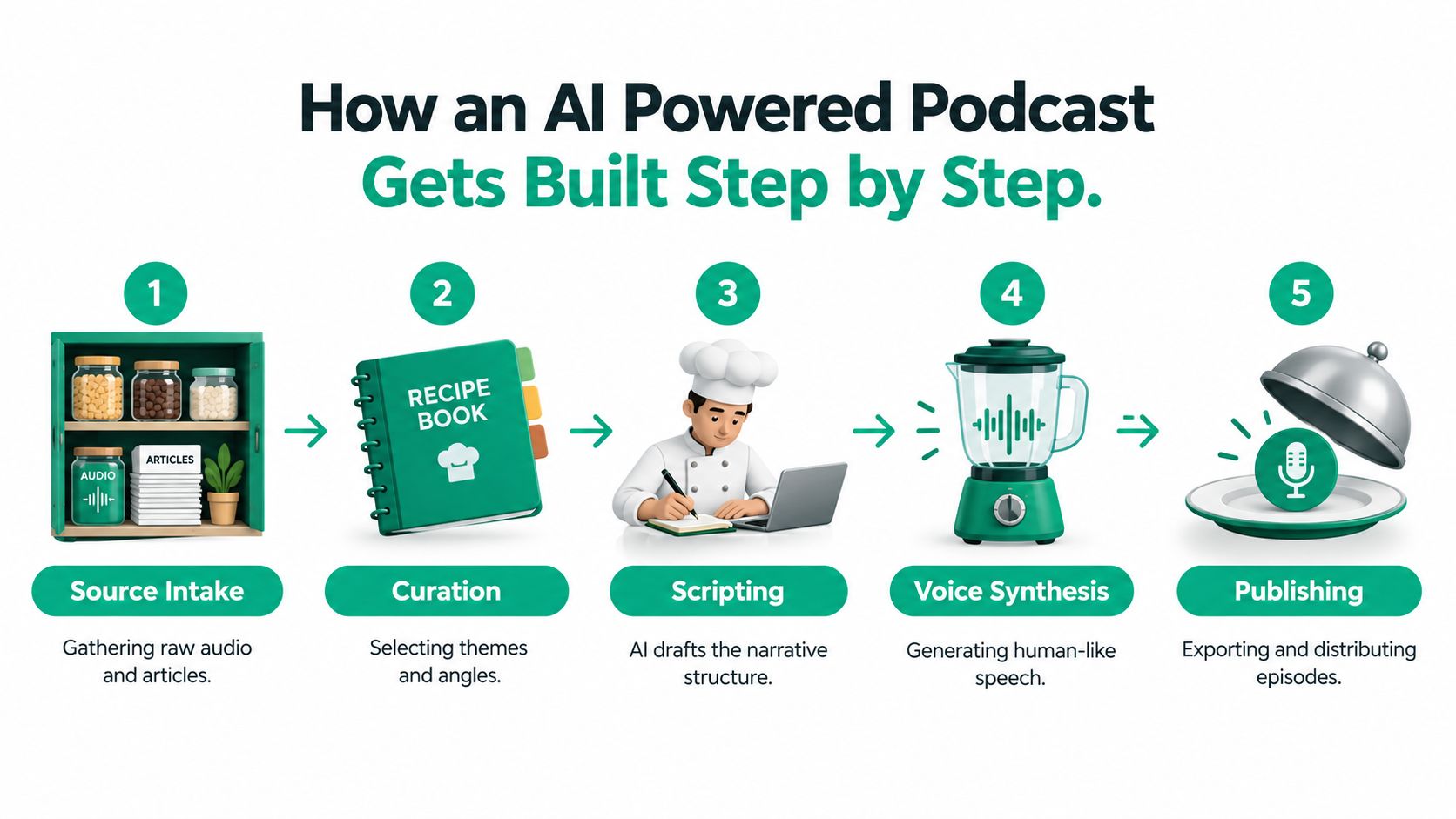
A text-to-speech engine assigns voices to roles and renders the script. It controls pronunciation, rhythm, emphasis, pauses, and the timing between speakers. A good system treats this as performance direction rather than simple reading.
The scheduler exports the audio, attaches metadata, and sends it to a private feed or player queue. The same source collection can become a quick briefing or a deeper discussion by changing the desired length, structure, and level of explanation.
The handoffs are where small mistakes multiply. Poor clustering creates a confused script, a thin script gives the voice little emotional direction, and rushed rendering can make a sound mix tiring even when the words are correct. For a practical look at turning source material into audio, see this guide to creating a podcast with AI.
A convincing voice does more than pronounce words correctly. It has to understand that a question usually rises at the end, that an important phrase needs space around it, and that a speaker may slow down before a difficult idea. Prosody, the pattern of pitch, timing, stress, and pauses, is what makes speech feel intentional.
Older speech systems assembled sounds from recorded fragments or converted text through relatively rigid rules. Neural systems such as WaveNet and Tacotron moved the process toward learned acoustic generation. Modern large speech models go further by learning patterns from spoken material, including pacing, emphasis, disfluencies, and conversational timing.
The challenge becomes harder as an episode grows. A short sentence can sound excellent in isolation, yet a long discussion may gradually lose energy, rush through a list, or give every sentence the same emotional weight. Two synthetic speakers also need to coordinate turn-taking. If one voice responds too quickly, the conversation feels cut together rather than shared.
Research on the PodAgent pipeline supports this modular view. Its Host-Guest-Writer design, voice-role matching, and enhanced speech synthesis significantly outperformed direct GPT-4 generation for topic-discussion dialogue, achieved 87.4% voice-matching accuracy, and produced more expressive speech through guided synthesis, according to the PodAgent research paper. The practical lesson is simple: planning, casting, and rendering should be treated as separate jobs.
VIBEVOICE reports high-quality generation for audio of up to 90 minutes with up to 4 speakers, using a system built around low-frame-rate acoustic and semantic tokenizers and an LLM-based diffusion model. Its evaluation reports improvements over existing baselines on naturalness, coherence, realism, and word error rate in the published research.
Listeners still catch familiar tells: excitement that arrives too late, a proper noun pronounced incorrectly, a laugh that doesn't quite belong, or a confident tone attached to an uncertain claim. Synthetic voices may pass the first casual moments of listening, but sustained attention exposes the seams.
You can hear the range of current systems in collections of studio-quality voice clips. For a plain-language explanation of the underlying process, compare it with this guide to what voice synthesis means. The important point isn't that every generated voice sounds human. It's that the technology has become good enough for listeners to judge the editorial quality rather than dismissing the format immediately.
The best use case is usually a repetitive listening job with dependable source material. AI handles volume, filtering, recurring schedules, and language changes well. Human shows still have an edge when the value depends on relationships, original reporting, lived experience, or visible accountability.
| Use case | What AI delivers | What a human show still wins on |
|---|---|---|
| Commuter briefing | Turns selected articles into a focused update for a fixed travel window | Host personality, field reporting, and editorial judgment |
| Study series | Reworks papers, notes, and concepts into repeated explanations | Expert teaching, dialogue with students, and feedback on misunderstandings |
| Industry roundup | Tracks developments across several sources and keeps the format consistent | Interviews, investigative context, and responsibility for conclusions |
| Multilingual feed | Produces narration and scripts for listeners who prefer another language | Cultural nuance, local idioms, and native human delivery |
A developer might save documentation, product announcements, and technical commentary for an overnight feed. The next morning's episode can explain what changed and why it matters before the workday begins. The advantage is not theatrical performance. It's that the listener doesn't have to manually assemble the briefing.
A medical student could turn approved lecture notes and papers into a sequence of review episodes. That audio can support revision between classes, but it shouldn't replace a qualified instructor, especially when a generated summary leaves out a qualification or turns a complex finding into a simple rule.
A marketer following direct-to-consumer brands might want a compact daily roundup before a team stand-up. AI can gather recurring signals from selected sources, but a human analyst remains better suited to judging whether a trend is strategically meaningful or merely loud online.
Multilingual delivery is valuable for accessibility and convenience. It can reduce the work involved in creating parallel feeds, yet direct translation may miss cultural context, technical terminology, or the tone expected by a particular audience. A listener should treat language coverage as a starting point, not proof of perfect comprehension.
Choose automation for repetition. Choose human production for judgment. The more an episode depends on original access, responsibility, or emotional chemistry, the less sensible full automation becomes.
Tools that help repurpose audio and video can also be useful alongside podcast workflows. For example, a creator comparing options for the best clip generator for Twitch is solving a related distribution problem, turning one source into formats suited to different channels.
A polished voice can hide weak editorial work. A model may invent a citation, combine two sources incorrectly, or preserve a claim from an article that has since been corrected. A second fact-checking pass can miss the same error if it relies on the generated script rather than opening the original source.
Long episodes have their own failure modes. Delivery may flatten after the opening, a numbered list may acquire awkward pauses, and two speakers may interrupt each other at the wrong moment. Voice cloning adds a separate concern because a recognizable person's voice can be reproduced in ways that confuse listeners about consent and authorship.

Policy is moving faster than many listening habits. The ZenMic summary of an industry report places the AI podcast host software market at $1.57 billion in 2025, with a projection of $2.04 billion in 2026 and $5.81 billion by 2030, representing a projected 30.1% CAGR. The same summary identifies August 2, 2026 as the date when new EU AI Act transparency obligations begin applying to AI-generated content, including synthetic voice, in certain contexts. These are projections and policy details, so publishers should verify the current requirements through authoritative legal guidance and the referenced report summary.
The evidence gap matters as much as the technical progress. Recent work describes AI-generated podcasts as potentially useful supplemental learning tools, but emphasizes the need for review and the limited public guidance on episode length, pacing, and adapting depth to different audiences in research on AI-generated podcasts in education and health. There isn't enough public evidence to assume that an individualized two-host episode improves comprehension or retention compared with a carefully made human show.
Listeners can protect themselves with a few habits:
Start with the job, not the voice. Decide whether you want a commute briefing, a study companion, a research digest, or a private update for a small team. That choice determines the useful source types, episode length, delivery time, and amount of explanation.
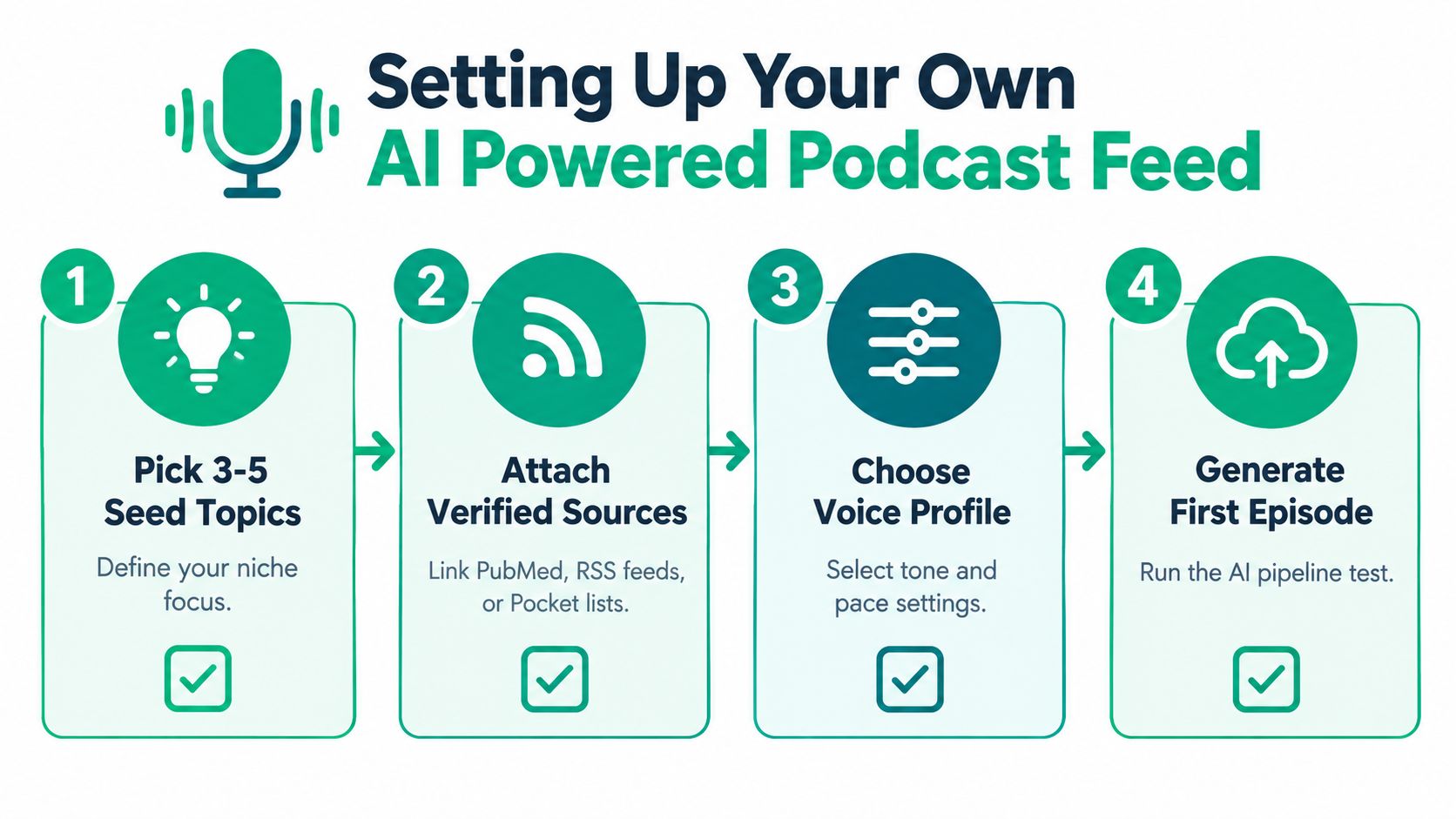
Choose three to five seed topics that belong together. “Technology” is broad enough to produce noise. “Developer tools, data privacy, and cloud security” gives the curator a more useful boundary.
Attach sources you already trust. RSS feeds work well for recurring publications, PubMed alerts suit academic monitoring, and saved Pocket lists can collect articles manually. Add PDFs, notes, or YouTube channels only when you have the right to use them and can identify the material clearly.
Then choose the performance:
The first run should be a preview, not a commitment. Listen for source coverage, repeated points, strange pronunciation, and whether the hosts explain unfamiliar terms. If a topic receives too much attention, narrow the source list or change the editorial instruction before scheduling future episodes.
For private listening, a private podcast RSS feed can keep recurring episodes separate from public directories. Rooy Development's service, available through Podcast-Generator.ai, accepts topics and sources such as websites, PDFs, notes, and YouTube channels, then creates scheduled episodes with two-host scripts, MP3 delivery, private feeds, and multilingual output in 40+ languages, as described by the publisher.
Empty feed: Confirm that sources are accessible, current, and contain items matching the seed topics. A narrow filter can be useful, but an overly narrow one starves the queue.
Monotone delivery: Change the voice, shorten long paragraphs, add explicit pauses, or split dense explanations into turns between hosts.
Ignored sources: Use fewer sources during testing and label them clearly. If the system still skips them, check whether the platform can read the file, page, or channel format.
Voice change: Save the episode history and source settings before switching voices. A new voice should alter delivery, not erase the editorial trail that tells you what the feed has already covered.
The next phase will be shaped by three connected pressures: a large listening habit, a growing software category, and rules that require clearer disclosure. Edison Research's Infinite Dial 2026 reported record U.S. podcast reach, with 80% of Americans age 12 and older, or 230 million people, having ever listened to or watched a podcast, while 58%, or 167 million, consumed one in the last month and 45%, or 130 million, did so in the last week. The report also found that 57% had both listened to and watched a podcast, showing why AI podcast products increasingly need to work across audio and video formats. The figures are reported in this Edison Research coverage.
The market signal points toward infrastructure rather than novelty. The ZenMic summary places AI and technology podcasts in the top ten genres for the first time at roughly 7% of global listening hours, while its market projection describes rapid expansion in software for synthetic hosts and voice production. At the same time, transparency obligations will push publishers to disclose when a voice or episode is generated, especially where a listener could mistake simulation for a real person.
| Force | 2026 signal | Likely impact |
|---|---|---|
| Audience habit | Podcast listening and watching have reached record levels in the United States | Personalized feeds can attach themselves to an established routine |
| Production software | AI host and synthetic-voice tools are moving into a dedicated market | More products will separate research, scripting, casting, and rendering |
| Regulation | EU transparency obligations for certain AI-generated content begin applying on August 2, 2026, according to the cited industry summary | Disclosure becomes part of publishing operations, not an optional note |
| Listener expectations | People want audio that fits commutes, study, work, and language preferences | Feeds will compete on relevance, source clarity, pacing, and control |
| Evidence quality | Research remains concentrated in pilots and smaller studies | Buyers will need outcome evidence instead of relying on voice realism alone |
The strongest products won't just make synthetic hosts sound smoother. They'll show where each claim came from, let listeners control depth and cadence, preserve feedback without becoming intrusive, and make uncertainty audible. Long-form generation will also require better speaker-state tracking and planning so that a technically fluent voice doesn't lose the thread halfway through an episode.
AI powered podcasting is becoming a layer between information and attention. Treat it like a useful production assistant, not an automatic authority. Start with a narrow feed, verify what matters, and adjust the workflow around the listening job you have.
Rooy Development offers a practical way to test that workflow by turning selected websites, PDFs, notes, and YouTube channels into scheduled two-host episodes delivered as MP3 files or a private feed. Visit Rooy Development to build a small personalized feed, listen to the first preview, and decide whether AI audio fits your commute, study routine, or research habit.
Transform your content into engaging podcasts in seconds with our AI-powered platform.
Get Started Now