
How to Create Podcast with AI Fast
create podcast with aiai podcast generatorautomated audio feedsai voice synthesispodcast workflow
16 min read

The most popular advice about how to create a podcast with AI is also the least useful: choose a tool, enter a topic, click generate, and publish. That workflow can produce an audio file, but it doesn't produce a dependable show. A real podcast needs a point of view, relevant sources, an audience fit, natural delivery, and a review process that catches errors before listeners do.
The practical opportunity is more interesting than fully synthetic hosting. In 2026, independent industry coverage reported that about 25% of new podcasts launched used AI voice generation, AI-powered script assistance, or AI multilingual dubbing, while fully AI-hosted podcasts represented under 3% of total listening (Digital Applied podcast statistics). AI is becoming a production layer, not a wholesale replacement for editorial judgment.
A one-click generator can produce speech, but it cannot define a dependable show. The production decisions still include source selection, claim verification, audience fit, pacing, and approval before publication. A reliable AI podcast therefore runs as a pipeline: show design, source curation, scripting, voice generation, editing, delivery, and feedback are separate stages with clear handoffs.
That distinction matches the current market. AI supports many parts of new-show production, while fully synthetic hosting remains a small listening format, as earlier industry reporting indicates. Creators gain more from assisted research, faster scripting, multilingual adaptation, transcription, show notes, and clips than from removing every human decision.
A single episode answers one question. A recurring personalized feed responds to changing questions over time. It could deliver a morning briefing from selected industry sites, a study series based on course materials, or a multilingual digest shaped by a listener's interests and previous feedback.
This model changes the production brief. Ask:
Podcast consumption is large enough to support specialized formats. Global reporting estimates 584.1 million monthly podcast listeners worldwide, with a projection of 651.7 million by 2027 (global podcast consumption data). That audience size creates room for narrow, useful feeds alongside broad public shows.
Practical rule: Use AI to increase the number of relevant editorial decisions you can support, not to avoid making editorial decisions.
AI can compare source material, draft an outline, generate dialogue, and render multiple languages quickly. Human review still needs defined gates. Weak inputs produce weak scripts. An error in a source can sound more credible after fluent narration. A voice that gives every subject the same rhythm will make accurate writing tiring to hear.
Set approval points before production begins. Check the source set before scripting, verify claims before recording, listen for awkward pronunciation and pacing after voice generation, and review the final mix before delivery. Recurring feeds also need feedback loops, so listener responses can refine future topics, sources, and episode length.
A reviewed episode can support more than audio publication. Producers can clip and caption it, then repurpose podcast audio to video for other channels without rebuilding the story each time. The broader workflow is outlined in this guide to an AI podcast generator.
A good AI podcast starts before the script prompt. It starts with a source system that tells the generator what matters, what is authoritative, and what should be excluded. The aim isn't to collect the largest possible library. It's to create a useful editorial boundary.
Begin with the audience rather than the tool. Write down the listener's recurring needs, preferred depth, knowledge level, and acceptable episode length. “Technology news” is too broad for a dependable feed. “Practical developments in search, content operations, and AI tools for marketing teams” gives the curator a more useful filter.
Different source types serve different purposes. A company announcement may establish what a product claims. A technical paper may provide the underlying method. A practitioner note may explain implementation friction. A video may capture a demonstration that isn't available in written form.
A heterogeneous source set can include:
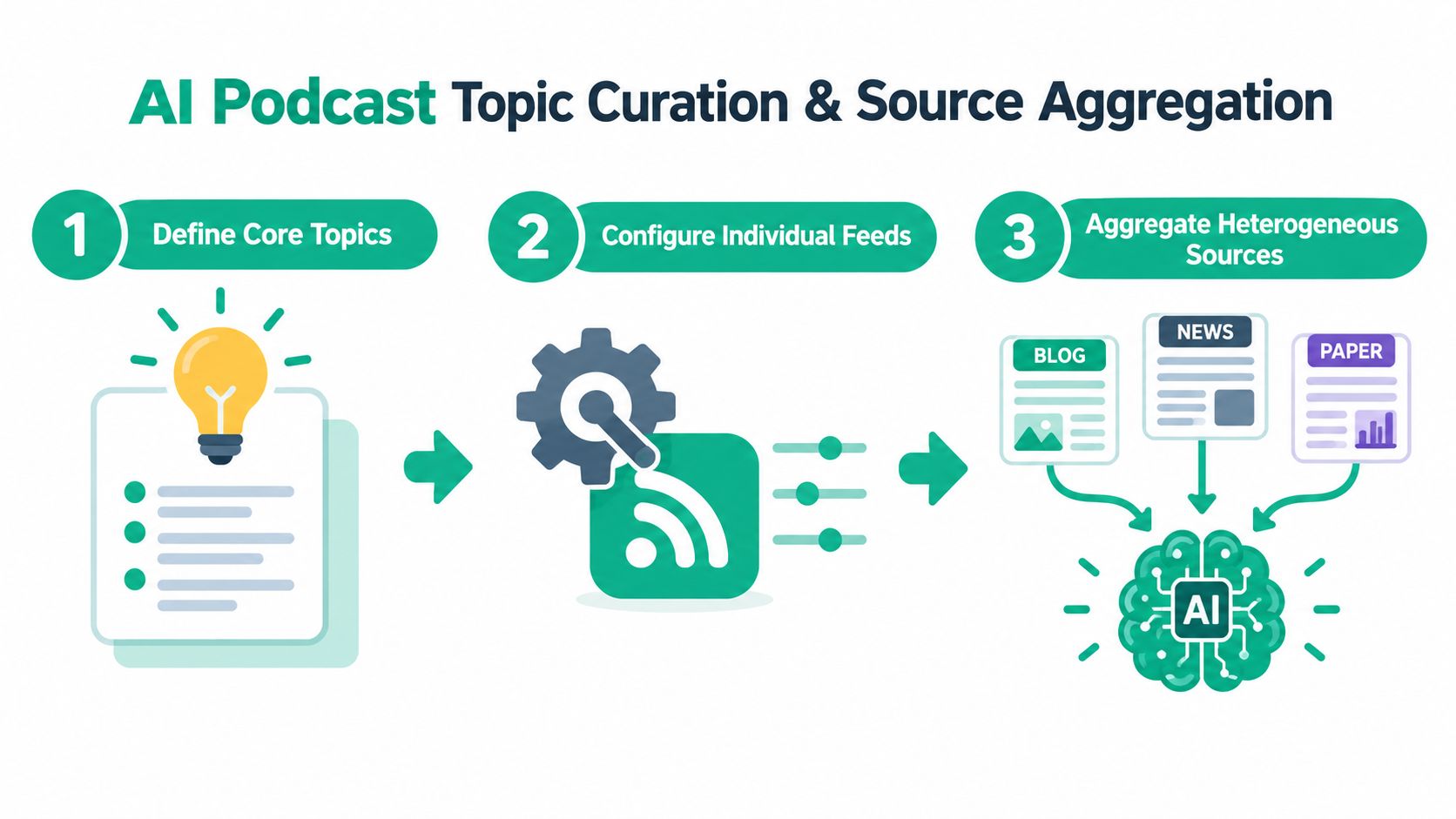
The source mix should also reflect the episode's purpose. A commuter briefing needs timely, concise material. A study series needs stable references and progression. A newsletter roundup needs consistent monitoring and a clear rule for deciding which items deserve airtime.
Curation becomes unreliable when discovery and verification are treated as the same action. Let automation find potentially relevant material, but require the system or producer to identify which passages support each important point. A source list alone isn't enough. The script should preserve the relationship between a claim and the document, page, timestamp, or URL behind it.
For time-sensitive topics, enable current web research only when the feed needs it. That setting can keep an industry briefing fresh, but it also raises the review burden. For evergreen learning content, a controlled library may be safer than continuously adding new pages.
Use a simple intake record for every source:
| Field | Production purpose |
|---|---|
| Source title | Identifies the material in the editorial log |
| Publisher or author | Helps assess authority and context |
| Publication date | Separates current updates from background |
| Content type | Distinguishes research, commentary, documentation, or video |
| Intended use | Defines whether the source informs facts, examples, or discussion |
| Review status | Shows whether a human has checked the material |
A system that detects new posts on subscribed sites and channels can reduce monitoring work, but it shouldn't decide automatically that every new item belongs in the next episode. Relevance, duplication, conflicts between sources, and audience fatigue still require editorial criteria.
Source discipline beats prompt cleverness. A detailed instruction can't compensate for an undifferentiated source library.
Before generating an outline, remove duplicate pages, outdated versions, promotional material that lacks substance, and documents outside the stated topic. Mark sensitive or copyrighted material clearly. If a source is private, decide who is allowed to hear the resulting feed and whether the content can legally be transformed into audio.
A source-backed outline does not become a usable episode by itself. The production task is to turn selected information into a conversation with clear roles, controlled pacing, and review points before audio rendering. A two-host format works when each voice serves a distinct purpose. One host can represent the listener's practical questions, while the other supplies context, tests assumptions, or connects separate sources.
Define the brief beyond the topic. Include the audience profile, desired depth, episode purpose, exclusions, and preferred structure. A technical briefing might open with the development, explain its significance, compare competing interpretations, and close with practical implications. A study episode could introduce a concept, test it with an example, and revisit it in a later installment. These instructions give the script engine boundaries that can be checked against the source-backed outline.

Natural dialogue comes from useful tension, not random interruptions. Assign one host to clarify and the other to question. Specify when they should disagree, define a term, acknowledge uncertainty, or move on instead of repeating the source.
A practical dialogue brief can include:
Do not ask the system for “natural” audio without defining how the conversation should work. Naturalness depends on turn length, restrained interruptions, varied sentence shapes, responsive follow-up questions, and pauses that match meaning. A realistic voice can still sound artificial if every sentence receives identical emphasis.
Flow's product brief describes a roster of 30 curated voices with emotional inflection, pacing, and dynamic pauses. Those controls matter only when the script supports them. A cautious explanation should sound measured. A surprising finding can use a shorter pause and a more animated response. A sensitive topic needs restraint rather than theatrical enthusiasm.
Multilingual production adds a separate editorial pass. Flow is described as generating and voicing content natively in 40+ languages, rather than reading a translated script. Native-language output still needs review for names, idioms, acronyms, cultural references, and register. A literal equivalent can be grammatically correct yet unsuitable for the intended audience. This multilingual text to speech guide offers implementation ideas for multilingual narration.
Use a staged workflow: approve the source-backed outline, generate the dialogue in the target language, review the transcript, then render the final audio. Keep the transcript available after rendering so a reviewer can compare pronunciation, emphasis, and wording against the approved script.
Long-form audio exposes weaknesses that short demonstrations hide. The 2026 vibe-podcasting report at pexo.ai notes that long-form text-to-speech quality has plateaued around 4.7 to 4.8 MOS, so workflow control matters alongside voice selection (practical AI podcasting guidance). Test the longest names, numbers, quotations, and technical passages before committing to a full episode. If those passages fail, revise the script or voice settings first, rather than discovering the problem after the complete feed has been rendered.
A personalized podcast only becomes useful when it arrives predictably. The delivery schedule should follow the listener's routine, not the generator's convenience. A daily briefing may suit a short commute, while a study feed may work better as a planned sequence with enough time between episodes for review.
Start by defining four operational settings:
The fallback matters. A system that publishes merely because the calendar says so will eventually fill the feed with repetition or weak material. “No episode this cycle” can be a better editorial outcome than forcing a summary from thin evidence.
The production chain should preserve editable segments whenever possible. Keep the source list, outline, script, transcript, audio segments, metadata, and final MP3 connected by an episode identifier. If a name is corrected after rendering, you should be able to regenerate that segment instead of rebuilding the entire file.
The output can then be delivered as a clean MP3 file, a private feed, or a destination suitable for an LMS or internal distribution. A private feed is particularly useful for personalized briefings, internal education, client materials, and study plans. This private podcast RSS feed guide covers the delivery concept in more detail.
Likes and skips should not be treated as a vanity dashboard. They can inform topic selection, episode depth, tone, and pacing. A skip near the opening may indicate weak framing. A repeated completion of source-heavy episodes may justify more technical detail. A like on a specific topic doesn't automatically mean the listener wants every adjacent topic included.
Use feedback as a signal with context:
Automation can apply these signals to future selection, but a producer should periodically inspect the changes. Otherwise, the feed may optimize for immediate clicks while drifting away from its original purpose.
AI podcast quality fails long before pronunciation becomes a problem. A fluent synthetic voice can deliver an incorrect date, merge people with similar names, misread a technical abbreviation, or turn a cautious source into a definite claim. Long-form audio also becomes expensive to fix when the workflow produces only a final MP3 or WAV file without segment-level structure.
Treat quality control as a sequence of review gates, not a final listen. Each gate should catch errors before they become harder to trace. Review the brief, verify sources, correct the transcript, inspect the recording, and complete factual checks before release.
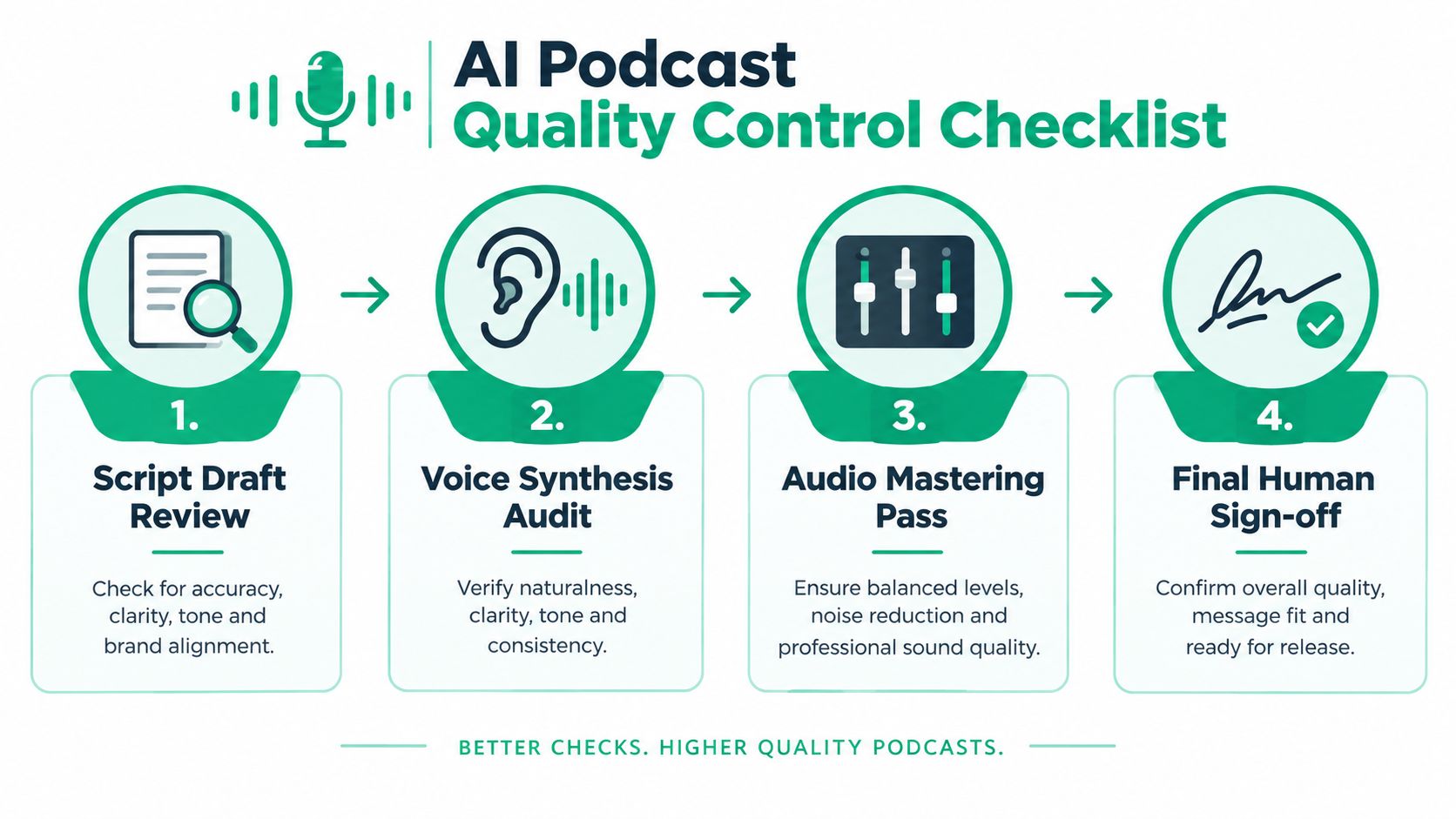
Before the system writes dialogue, define the audience, purpose, source boundary, and acceptable level of uncertainty. “Summarize the latest news” gives the generator too much discretion. A useful brief names the subject, date range, source types, exclusions, and intended listener outcome, creating a standard the producer can review.
For recurring personalized feeds, keep the brief versioned. A changed audience or topic boundary should be visible in the episode record, rather than hidden inside an evolving prompt.
Verify that every material claim has a source and that the source supports the exact wording. Watch for summaries that combine separate passages into a conclusion no source makes. For web-based episodes, preserve URLs and publication context in the production record. For PDFs and videos, retain page references or timestamps where practical.
Copyright and consent decisions belong in the same record. Permission to access a page does not automatically permit reproducing its content in a monetized or private audio product. Define what may be quoted, summarized, transformed, or distributed before publication, and record the decision.
Read the transcript while listening to the synthesized audio. Check names, acronyms, numbers, foreign-language terms, speaker turns, pauses, and emphasis. Then listen without the text. Awkward rhythm, repetitive reactions, and unnatural transitions are easier to hear when the eye is not compensating for the ear.
A practical audio pass checks:
The final gate is human sign-off. A shared review log or best editorial workflow software for teams can assign source checks, transcript corrections, audio review, and approval while preserving episode history.
Disclose AI involvement in language the audience can understand. Clear labeling matters for synthetic voices, multilingual adaptation, personalized content, and episodes built from external sources. Transparency cannot resolve every trust concern, but hidden automation can undermine credibility even when the audio sounds polished.
A useful AI podcast workflow becomes easier to evaluate when the listener's problem is concrete. The same pipeline can support very different feeds, but each one needs its own source rules, episode shape, and review standard.
A busy professional may have a reading queue spread across industry publications, company updates, research pages, and videos. The feed can monitor selected sources, filter material against a defined topic brief, and turn the strongest items into a scheduled audio digest.
The human contribution is editorial triage. Someone should decide whether a product announcement deserves attention, whether two sources are reporting the same event, and whether a claim is sufficiently supported. The listener gets a focused briefing instead of a generic stream of headlines.
A student can combine lecture notes, assigned readings, reference PDFs, and selected explanatory videos. Rather than generating one enormous summary, the producer can create a sequence that introduces a concept, explains its relationship to earlier material, and revisits difficult points in later episodes.
The review gate is particularly important here. Incorrect simplification can teach the wrong mental model, while an overconfident voice can make uncertainty disappear. The best episodes distinguish definitions, examples, competing interpretations, and questions the student still needs to resolve.
A creator or newsletter curator may work from fragmented material across websites, PDFs, personal notes, and YouTube channels. A recurring feed can unify those inputs, produce a two-host conversation, and deliver versions for listeners who prefer different languages.
Native-language narration can reduce friction, but it doesn't remove cultural or editorial responsibility. Reviewers should check names, idioms, local references, and whether the tone fits the audience. Source attribution should remain visible in the episode notes even when the spoken version is designed for easy listening.
Rooy Development offers a service that curates selected topics and sources, generates two-host podcast episodes, supports multilingual narration, schedules recurring delivery, and provides private-feed output. If you want to test this operational model, visit Rooy Development and start with one narrowly defined feed, a small source set, and a clear human approval step.
Transform your content into engaging podcasts in seconds with our AI-powered platform.
Get Started Now