
How Much Money Do Twitch Streamers Make in 2026
Twitch incomestreamer earningsTwitch affiliatelive streaming moneycontent creator income
15 min read
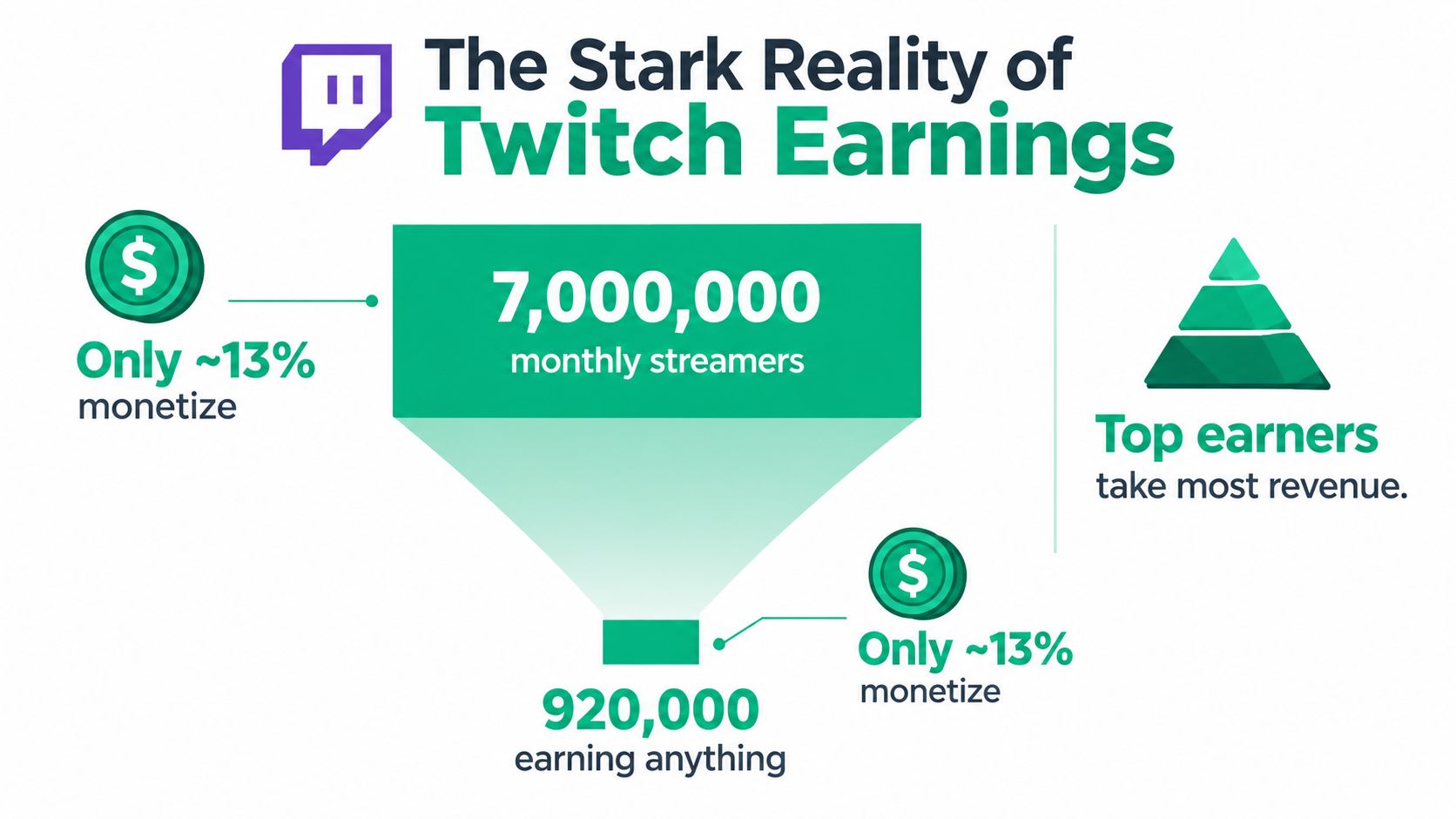
More than $35 million went to the top 10 Twitch streamers in one widely cited estimate, yet roughly 87% of Twitch streamers earn nothing. Only about 13% generate any income at all, so the honest answer to “how much money do Twitch streamers make?” ranges from zero for most creators to millions for a very small elite.
That gap matters more than any headline about a superstar's payout. Twitch isn't a typical salary ladder where every creator moves steadily from one income band to the next. It's a winner-take-most marketplace, and the difference between a hobby channel and a sustainable business usually comes from monetizable live attention, recurring support, and revenue outside Twitch itself.
About 920,000 of Twitch's roughly 7 million monthly streamers earn any income, according to one 2026 industry summary. That leaves approximately 87% earning $0, while only about 13% monetize at all. A separate poll found that 72.8% of smaller streamers make nothing, and just 15.2% earn between $1 and $25 per month. The industry summary behind these figures makes the distribution problem impossible to ignore.
The platform can feel like a goldmine because viewers encounter the most visible channels first. Those channels have enough audience density to generate subscriptions, advertising inventory, donations, sponsorship interest, and sales opportunities at the same time. Smaller creators usually have to build each revenue stream manually, often before their audience is large enough for any one stream to become meaningful.
An average would hide the exact information a new creator needs. If a handful of highly visible channels earn huge sums while most channels remain near zero, the average income tells you little about your own prospects. The more useful questions are:
A creator who answers those questions is building a business. A creator who only watches follower count may be tracking popularity without tracking income potential.
This is also why tools and products aimed at creator businesses can matter before a channel becomes large. For example, creators exploring branded products may find AI merch for creator income useful when they want to test an additional revenue path instead of depending entirely on Twitch payouts.
Practical rule: Treat Twitch as a funnel, not a paycheck. Viewers enter through content, engaged viewers return live, and a smaller group funds the channel through several forms of support.
The realistic baseline is uncomfortable but useful. The people who ask how much money Twitch streamers make aren't choosing between several profitable income tiers. They're trying to determine whether their channel can move from zero to a small recurring amount, then from hobby income to a dependable side business.
Twitch monetization starts with several separate mechanisms, and each rewards a different kind of audience behavior. Subscriptions create recurring revenue, Bits let viewers pay for visible interaction, ads monetize attention during live broadcasts, and donations or external support give loyal viewers another way to contribute.
Subscriptions provide the clearest math. Twitch offers subscription tiers priced at $4.99, $9.99, and $24.99 per month, while Twitch typically retains 50% of subscription revenue for Affiliates and most creators. At the standard split, a Tier 1 subscription produces about $2.50 for the streamer before payment processing and local taxes. Those figures are documented in Twitch's channel analytics guidance.
A creator relying on Tier 1 subscriptions alone would need roughly 400 paying subscribers to reach about $1,000 per month. Every additional 100 Tier 1 subscribers adds about $250 per month at that standard split. The arithmetic explains why a channel with a smaller but committed community can outperform a channel with more casual viewers.
That doesn't mean subscriptions are guaranteed income. Viewers can cancel, gifted subscriptions can fluctuate, and higher-tier subscriptions don't automatically translate into a proportional increase in active community participation. The useful metric is not just total subscribers, but recurring subscribers divided by the audience that regularly watches.
Bits work differently because viewers purchase them and use them to support particular moments. Ads depend on available inventory, viewer geography, ad delivery, and whether the creator can run them without damaging the viewing experience. Donations may be more direct, but they're also less predictable than recurring subscriptions.
Think of each live stream as a sequence:
That sequence is more useful than obsessing over raw follower totals. A practical Twitch marketing guide from Social Cloud also frames promotion around audience fit and creator visibility, which are critical when sponsorship value depends on more than a large follower number.
Creators who want to understand ad-specific mechanics can also review this guide to Twitch ad revenue. The central lesson remains simple: Twitch doesn't pay a fixed amount per follower or per ordinary view. It pays through monetization events, and those events depend on behavior.
Audience size matters, but average concurrent viewers are more useful than follower totals because concurrency measures how many people are present during a live broadcast. Independent estimates place channels with roughly 50 to 199 average concurrent viewers at about $120 to $1,400 per month, while creators averaging 1,000 to 10,000 viewers are often estimated at $5,000 to $30,000 per month. The audience-based estimates from Streamer Rise show how sharply income can change as monetizable attention scales.
| Audience position | Reported monthly range | What usually changes |
|---|---|---|
| 50 to 199 average concurrent viewers | $120 to $1,400 | Returning viewers, subscriptions, modest ads, early sponsor interest |
| 1,000 to 10,000 average viewers | $5,000 to $30,000 | Larger recurring support, stronger ad inventory, brand campaigns, external products |
| Top-tier channels | $100,000 or more | Large communities, premium partnerships, multiple revenue streams |
These are not salary bands. They're broad estimates, and the range inside each band is enormous. Two channels with similar concurrency can earn very different amounts if one has stronger subscription conversion, a more commercially attractive niche, or a better system for turning live content into off-platform assets.
The 50-to-199 viewer bracket looks promising until you separate total income from subscription income. One analysis reported that the median streamer in this band has 13 paid subscribers, producing roughly $32 to $210 per month from subscriptions alone, before other revenue is added. The analysis of smaller-channel earnings shows why a respectable live audience doesn't automatically create a respectable paycheck.
The practical implication is that small creators should improve conversion and retention before chasing every possible monetization feature. A tighter community ritual, clearer subscription value, and consistent schedule can matter more than adding another occasional stream.
At the upper end, top-tier stars can exceed $100,000 per month, but those channels represent a tiny fraction of the ecosystem. The most useful benchmark for an emerging creator is therefore not the superstar tier. It's the next threshold that changes the business: enough recurring income to fund better production, enough audience trust to attract relevant sponsors, and enough content to support other platforms.
A viewer count is a capacity signal. A revenue system determines how much of that capacity becomes cash flow.
A streamer's Twitch dashboard can understate the full business. Subscriptions, Bits, and ads may be only one part of monthly cash flow, while sponsorships, donations, Patreon, merchandise, affiliate sales, and YouTube content provide additional routes to revenue. An independent breakdown of Twitch and off-platform income estimates that a creator averaging 1,000 concurrent viewers might earn $8,000 to $25,000 per month in total, with approximately $4,000 to $8,000 coming directly from Twitch.
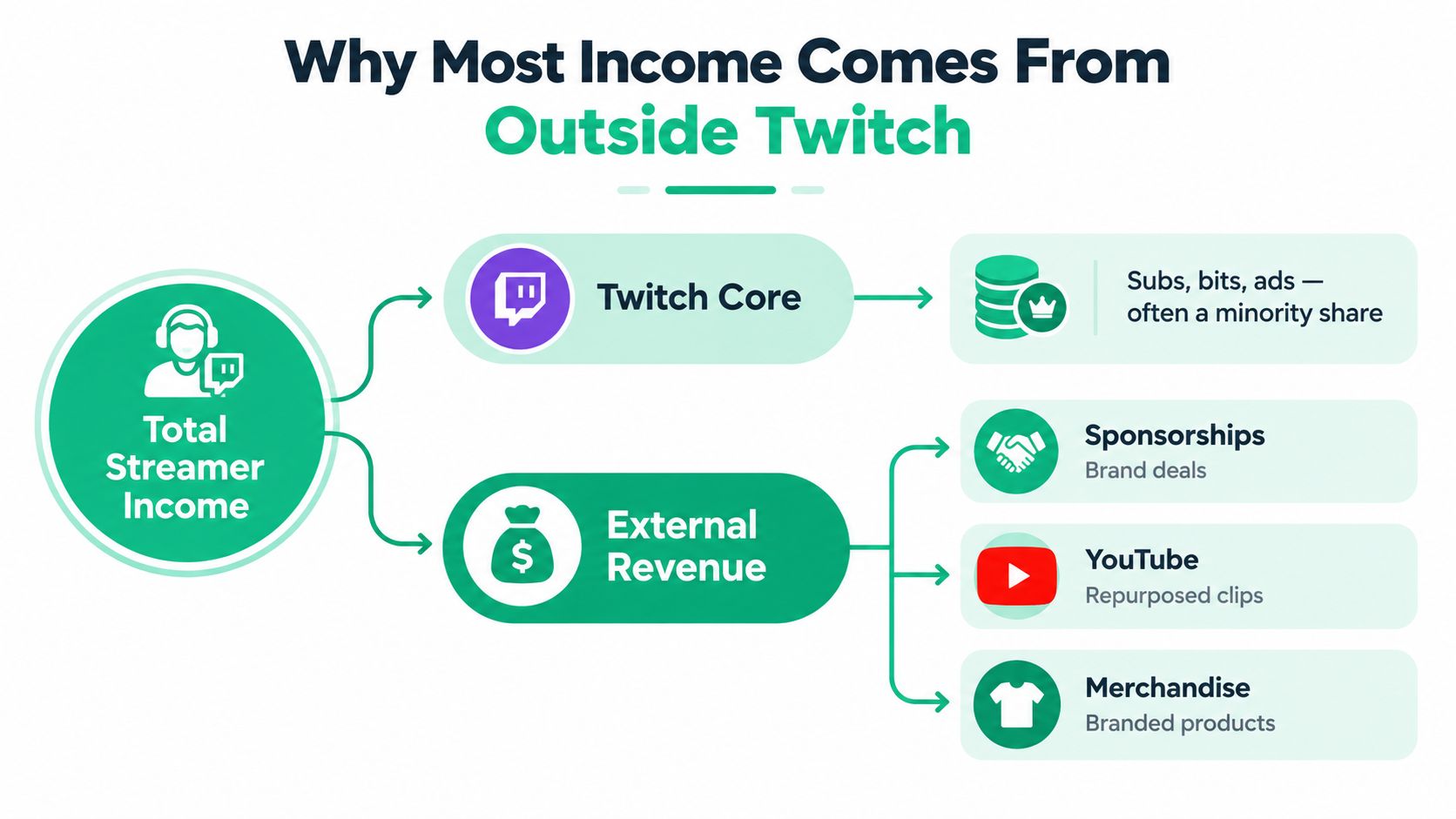
That distinction changes how you evaluate a channel. Someone may describe their income as “Twitch earnings” even when the largest opportunities came from a brand campaign, a YouTube audience, or a product launch that Twitch helped make possible but didn't directly pay for.
A sustainable streamer business usually has three layers:
The layers reinforce each other. A live broadcast creates moments for clips, clips attract new viewers, and a broader audience makes sponsorship or merchandise more credible. The creator's job is to preserve the connection while adapting each piece of content to the channel where it performs best.
Relying on one platform exposes the creator to changes in revenue splits, discovery, advertising demand, policy, and audience behavior. Diversification doesn't guarantee higher income, but it gives the creator more control over how an existing community creates value.
A YouTube strategy deserves particular attention because searchable and repurposed content can keep working after a live broadcast ends. Creators comparing platform economics can use this explainer on how much YouTube pays for 1 million subscribers, while remembering that subscriber count alone doesn't determine revenue.
The strategic conclusion is straightforward: Twitch is often the relationship engine, not the entire company. The stream builds trust, and the wider creator stack gives that trust more ways to produce income.
Public streamer stories usually distort the market because the most visible examples are also the least representative. A historical estimate reported $9.6 million for CriticalRole and $8.4 million for xQcOW, while also showing that top channels can capture sums many full-time streamers wouldn't approach over a decade. The estimate and its methodology are discussed by FinanceBuzz.

Those figures are useful as evidence of concentration, not as a blueprint. CriticalRole's scale and format aren't interchangeable with a solo gaming channel, and a celebrity creator's audience, brand access, and production capacity create conditions that a new streamer can't easily replicate.
The strongest lesson is not that a creator should imitate a particular personality. It's that top channels combine several assets:
A smaller educational streamer might apply the same principles through a focused teaching format, recurring community questions, and downloadable resources. A gaming creator might build around challenge formats, highlight clips, sponsor-fit categories, and merchandise. Those are strategic examples, not claimed case studies with invented earnings.
The difference between a sustainable path and a lottery-ticket fantasy is repeatability. A viral moment can create attention, but a reliable business needs a format that can generate another useful broadcast, another clip, and another reason for viewers to return.
A viewer should therefore judge a success story by its operating pattern. Ask what the creator does every week, how the audience participates, which revenue streams are recurring, and what continues working when the creator isn't live. The public payout headline is the least transferable part.
The fastest route to more income usually isn't streaming longer. It's improving the percentage of attention that becomes recurring support, then creating more ways for that support to continue outside the live channel.
Give subscribers a visible role in the community. Recurring segments, community votes, subscriber games, custom challenges, and clear recognition create reasons to subscribe that don't depend on guilt or constant promotion. Your objective is to make support feel connected to the shared experience.
Review your analytics after each broadcast. Note where chat becomes active, which segments retain viewers, and when people leave. Then place your strongest community moments where new viewers can understand the channel quickly.
Sponsors need more than a follower total. Prepare a concise media kit with your niche, audience description, average concurrent viewers, content formats, previous relevant work, and the action you want viewers to take. Pitch companies whose products naturally fit the broadcast instead of accepting any offer that arrives.
A smaller, focused audience can be commercially useful when the creator demonstrates trust and clear relevance. Explain how the product will appear in the stream, clip, description, or community workflow, and disclose sponsorships plainly.
Treat the live stream as raw material. Mark strong moments while you're live, then turn them into clips, short videos, searchable explanations, and a longer recap. This widens discovery without requiring another full broadcast.
If you're still planning the fundamentals, this guide to how you become a Twitch streamer can help organize the setup and monetization path. For broader content planning, a gear and niche planning guide is useful when deciding how Twitch content can support a wider creator identity.
When you qualify for improved platform terms or attract recurring sponsors, bring performance data to the conversation. Show retention, repeat viewers, subscription behavior, campaign outcomes, and the formats that produce the strongest response. Better terms are easier to discuss when you can connect them to measurable value.
Finally, protect the community experience. Aggressive ad timing, irrelevant sponsors, and constant sales prompts can reduce trust, which weakens every revenue channel at once.
A useful forecast starts with variables you control or can measure, not with a headline from a celebrity channel. Track your average concurrent viewers, recurring paid subscribers, subscription tiers, Bits, ads, donations, sponsorships, and external sales separately. Then update the estimate after each month rather than treating one strong broadcast as a new baseline.
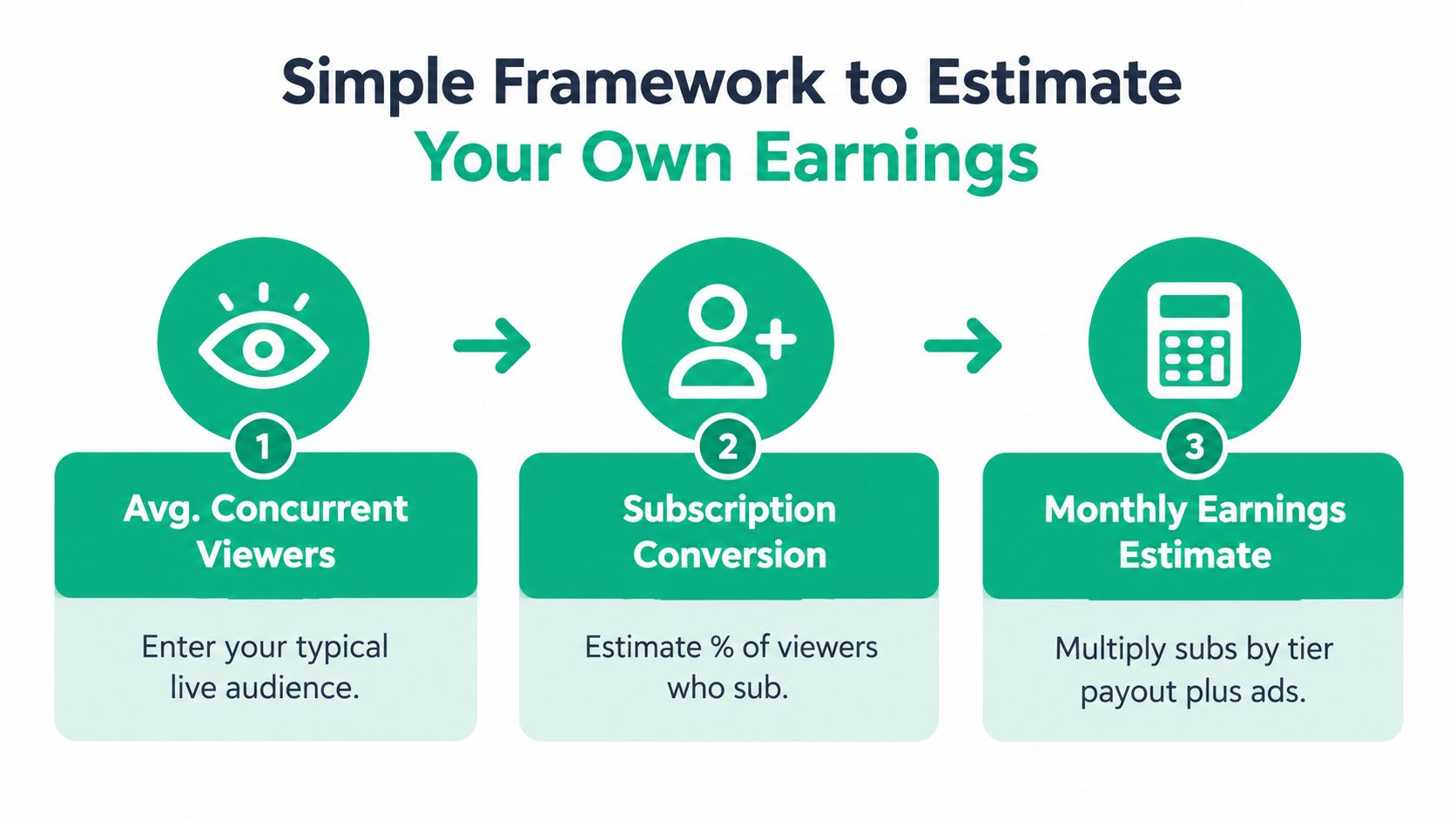
First, estimate recurring support. Count active paid subscriptions by tier and apply the payout rate that governs your account. Don't treat gifted subscriptions, one-time donations, or promotional spikes as permanent monthly income.
Second, add variable Twitch revenue. Record Bits, ads, and direct donations separately. Their value can change with broadcast frequency, audience behavior, and the quality of each live session, so use a conservative recent baseline rather than the best month.
Third, model external revenue. Add only sponsor agreements, merchandise sales, Patreon support, affiliate income, or YouTube revenue that you can reasonably expect to repeat. Keep one-off campaigns separate from recurring cash flow.
The result is a practical planning equation:
Monthly baseline = recurring subscriptions + typical Twitch variable revenue + reliable external revenue
Then create three versions: conservative, expected, and stretch. The conservative forecast helps you cover costs, the expected forecast guides decisions, and the stretch forecast shows what must improve before you invest more time or equipment.
Track the inputs that move the result. If concurrency rises but subscriptions don't, improve conversion. If subscriptions grow but external income stays flat, package the audience for sponsors or repurposed content. If every category depends on live hours, build an off-platform asset before increasing your schedule.
The answer to how much money Twitch streamers make becomes far more useful when you replace a generic average with your own operating model. Most creators won't become millionaire streamers, but a disciplined forecast can show whether your next realistic milestone is zero, a small side income, or a business worth scaling.
Rooy Development offers AI Podcast Generator, a service that turns selected websites, PDFs, notes, and YouTube channels into personalized two-host podcast episodes with source-aware research, multilingual narration, and scheduled private-feed delivery. Visit Rooy Development to turn streaming and creator-economy research into recurring audio briefings you can follow while commuting or working.
Transform your content into engaging podcasts in seconds with our AI-powered platform.
Get Started Now