How Can I Make My Voice More Feminine
feminine voicevoice feminizationvocal trainingspeech therapyvoice pitch
September 18, 2026
16 min read

You hear your recorded voice and pause before the sentence even finishes. The pitch may be higher, but the sound still feels unfamiliar, effortful, or disconnected from the person you know yourself to be. That reaction is common, and it doesn't mean you're failing.
The better question isn't only, “How can I make my voice more feminine?” It's how you can build a voice that remains comfortable, expressive, and recognizably yours during a real conversation. Voice feminization works best as coordinated retraining of pitch, resonance, prosody, articulation, and vocal weight, followed by steady practice until those choices carry over without constant monitoring.
A client may leave a practice session satisfied, then hear the old voice return during a phone call, a stressful exchange, or an unplanned laugh. A recording can sound lighter and more intentional, yet still feel disconnected from the voice they want others to hear. That gap is frustrating, but it gives useful information: the trained pattern has not carried into automatic speech.
I treat feminization as a stability-and-carryover problem, rather than a single pitch adjustment. Listeners hear several features at once: pitch, the perceived highness or lowness of sound; resonance, its tonal brightness or darkness; prosody, the melody and rhythm of speech; and articulation, how the mouth shapes sounds. Vocal weight, volume, and timing also affect the result.
Practical rule: If a feminine quality appears in one rehearsed sentence but disappears in conversation, the next target is carryover, not a higher note.
Pitch still matters, but raising it alone can produce throat tension and an artificial sound. Pushing the larynx upward may create a high tone that becomes unstable as the conversation continues. A more reliable approach coordinates pitch with resonance and articulation, then tests those changes in reading and spontaneous speech. A 2022 randomized controlled trial reported gains in mean fundamental frequency of 49 Hz in sustained vowels, 49 Hz in reading, and 29 Hz in spontaneous speech, along with increases in formant-related measures after therapy, in the American Journal of Speech-Language Pathology study.
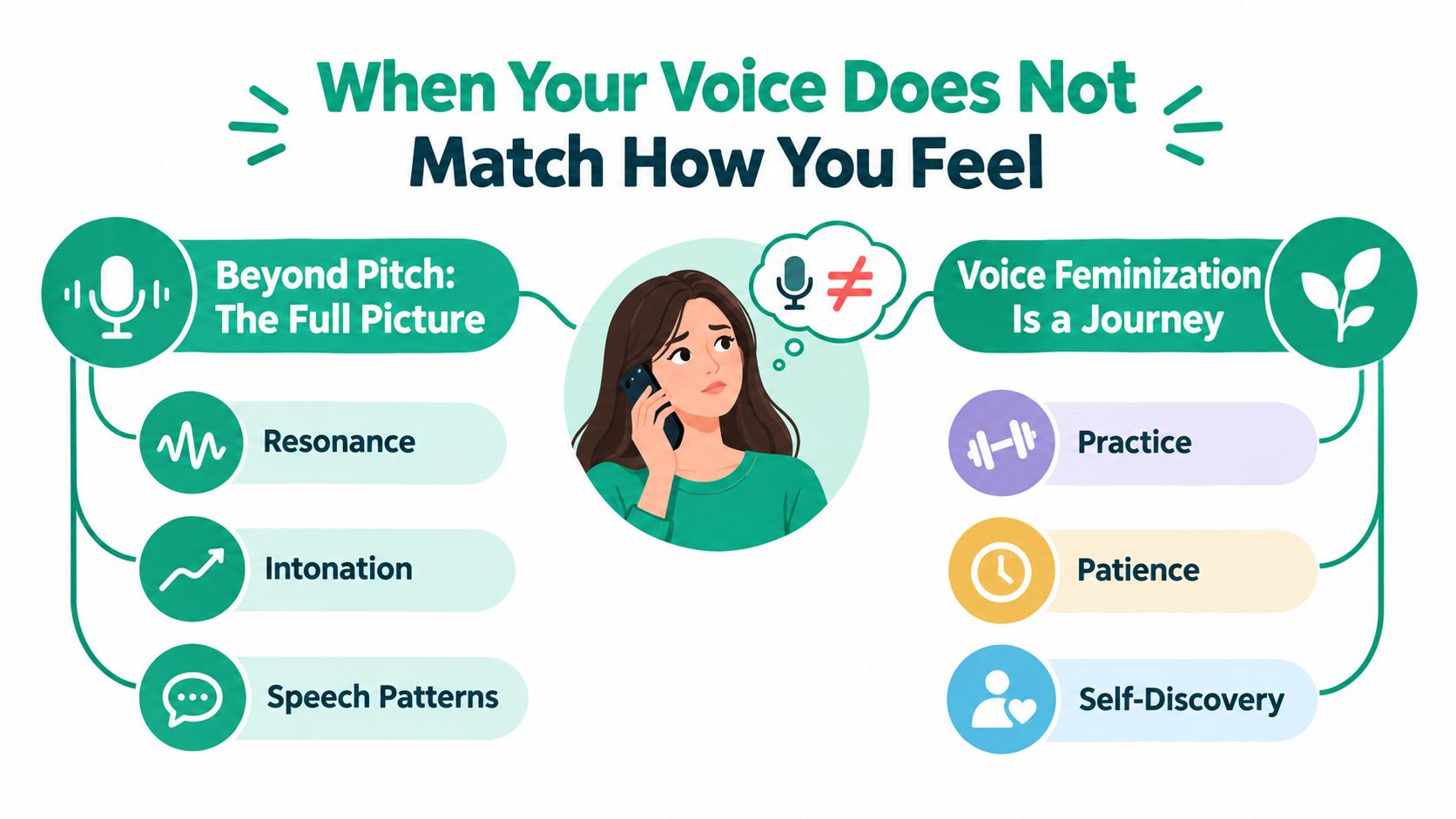
Progress comes from coordinated repetition over weeks and months. Practice should connect posture, breath, larynx movement, resonance, and speech patterns, while regularly checking whether the result remains comfortable under ordinary demands. The goal is a dependable communication option, not a performance that requires constant supervision. For situations involving synthetic or modified output, female AI voice options may be useful, but playback cannot replace healthy, embodied vocal control.
Distress about a recorded voice is not vanity. It identifies the distance between intention and automatic habit. The exercises that follow narrow that distance gradually, without forcing a pitch your body cannot sustain.
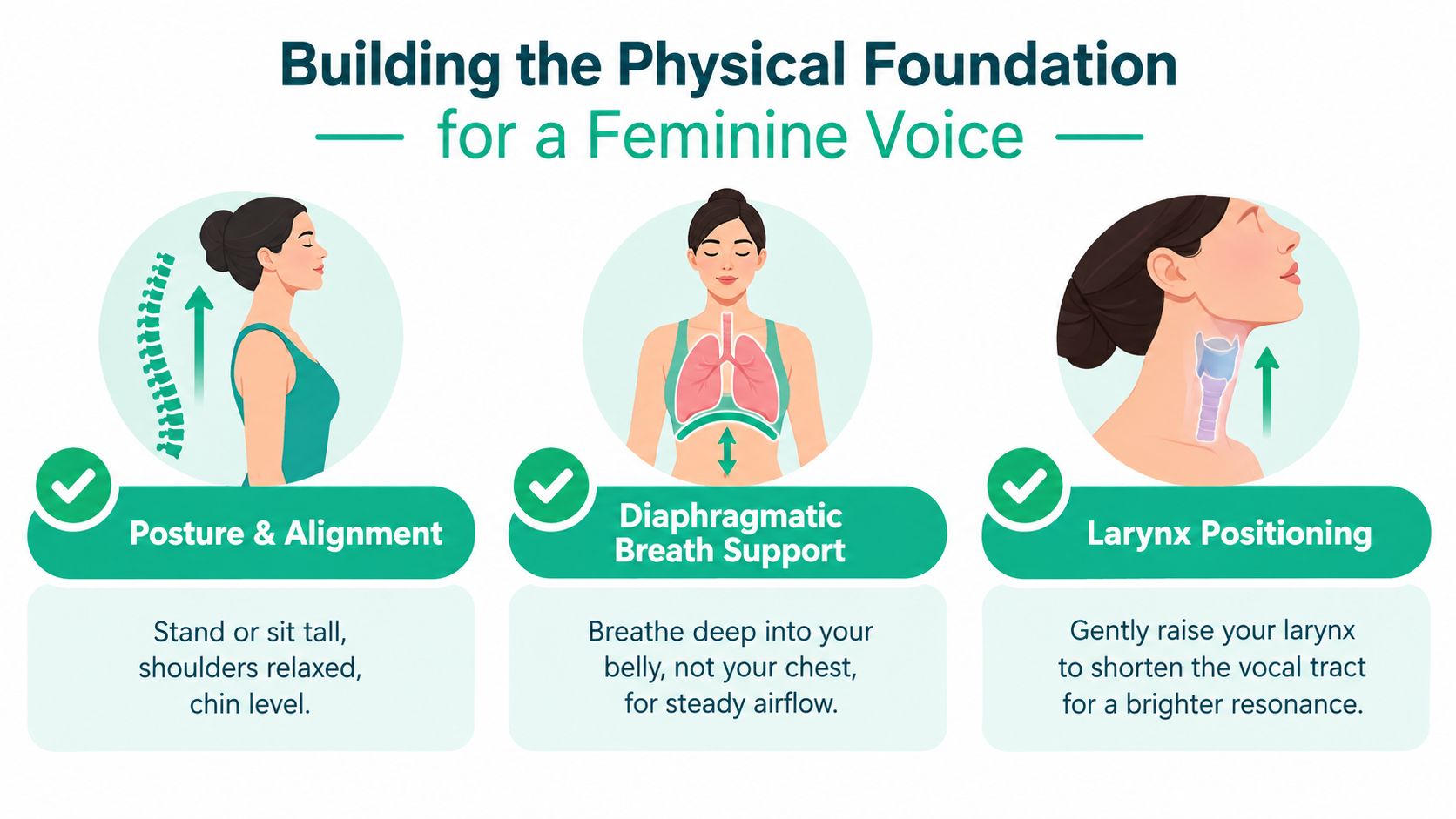
Before changing sound, make the body a more reliable instrument. Poor alignment, shallow breathing, and throat tension can make every later exercise harder. They also encourage you to mistake muscular effort for vocal progress.
Sit or stand tall without stiffening. Let your head balance over your spine, keep your chin level, and allow the shoulders to drop. Release your jaw by letting the teeth separate slightly, then notice whether the tongue is pressing hard against the roof of the mouth or lower teeth.
Use this reset before every practice session:
Diaphragmatic breathing doesn't mean shoving the stomach outward or taking the largest possible breath. It means allowing the lower breathing system to support a steady exhale, so a higher speaking pitch doesn't depend on throat squeezing. If your shoulders rise sharply or your breath runs out halfway through a phrase, reduce the amount of air and slow the exercise.
A slightly lifted larynx can contribute to a shorter vocal tract and a brighter quality, but forcing it upward with the throat muscles is a common route to fatigue. You can explore the movement by swallowing once, noticing the larynx's natural lift, and then releasing the swallow. Don't hold the larynx in the swallowed position.
A simple routine combines the elements: complete the posture reset, perform three rounds of diaphragmatic breathing, then hum comfortably while letting the larynx settle rather than pushing it. If you experience pain, persistent hoarseness, or a worsening sensation of tightness, stop and seek evaluation from a qualified clinician. For readers who want more context about jaw, tongue, and oral muscle coordination, check the center's guide from Pain and Sleep Therapy Center.
Skipping this foundation often produces a familiar pattern. The voice sounds promising for a short period, then becomes tired, breathy, pressed, or inconsistent. Build ease first, because a technically impressive sound that leaves you sore isn't a successful feminization strategy.
Pitch and resonance should be trained as linked variables. Pitch changes the musical frequency of your voice, while resonance changes where the sound seems to live and how bright or dark it feels. A higher pitch with a heavy, dark resonance can still be perceived as masculine, while a moderately raised pitch with a lighter, forward resonance may read more femininely.
A 2023 study summarized in PubMed identified an average fundamental frequency above 170 Hz as a typical training target near cisgender female norms, though no single number determines identity or how every listener will perceive you. A useful practice range for many feminine-presenting speakers is roughly 165 to 220 Hz in habitual conversation, but individual anatomy, language, accent, comfort, and vocal goals matter more than forcing a universal target.

Try this sequence after your physical warm-up:
The “mask” is a useful sensory image, not a literal instruction to send sound into a particular anatomical cavity. You're looking for a brighter oral sensation, clearer vowel shaping, and less heaviness. Lip trills can help you find steady airflow, but they're only useful if they remain relaxed.
A pitch monitor app can provide feedback during practice. Use it to notice patterns, not to police every syllable. The 2022 comparison study of gender-affirming voice training found hybrid training outperformed individual training on adherence and goal achievement, with 84% adherence versus 28% and 74% goal achievement versus 21%. The practical lesson is that feedback helps most when it supports repeated, structured practice rather than becoming a source of anxiety.
Use this video as an additional visual and auditory reference for exercise mechanics:
Many people reach a plateau after they can produce a brighter, higher voice in a quiet room. The sound works during an exercise, but ordinary speech remains flat or heavy. That plateau usually reflects a missing layer of prosody and articulation, not a need to keep pushing pitch upward.
Feminine speech perception often responds to movement across a phrase. Practice broader pitch contours, gentle rises on some conversational statements, varied rhythm, and deliberate emphasis rather than placing every sentence on one level. These patterns should remain authentic to you. A feminine voice doesn't require exaggerated cheerfulness, constant upward inflection, or a particular personality.
Write a few ordinary declarative sentences, such as “I'll call you after work” or “The appointment starts tomorrow.” Mark where you want the pitch to rise, fall, or hold with simple arrows. Read each sentence once with controlled exaggeration, then repeat it in a more natural version.
Use “Cinderella” phrases, meaning short phrases with gentle, expressive movement, to explore range without turning the exercise into performance. You might say, “I didn't expect that,” or “That sounds really good,” first with a wide contour and then with less movement. The purpose is to learn control, not to imitate a stereotype.
Articulation changes perceived brightness. Try lighter tongue-tip contact for consonants such as “t,” “d,” “n,” and “l.” Keep the jaw released and allow vowels a little more space in time without stretching them so far that speech becomes unnatural. A softer onset on vowels can also reduce the abrupt, heavy quality some speakers carry into phrases.
Use a read-then-paraphrase drill:
The paraphrase is the important part. Reading gives you predictable language, while spontaneous explanation reveals whether your new habits survive cognitive load. Add short voice messages, casual greetings, and conversations with a trusted person once the exercise feels comfortable.
Feminine prosody should become a set of choices you can access, not a script you must perform perfectly.
If a rising inflection feels false, keep the contour smaller. If lighter consonants make you lisp or lose clarity, reduce the change and return to intelligibility. Naturalness comes from coordination, and coordination develops when you practice expression in the situations where you speak.
Solo practice suits people who can notice strain, follow a clear plan, and return to exercises consistently. Recordings, apps, peer groups, and classes can provide motivation and useful reactions. Their limits matter, though. A pitch tracker may display frequency while missing resonance, vocal weight, fatigue, or the way your voice carries through ordinary conversation.
Structured support often improves carryover. In the 2022 comparison study, hybrid training produced stronger adherence and goal achievement than individual training. Both approaches raised speaking fundamental frequency and improved voice-related quality-of-life outcomes, as documented in the published comparison research. Formal therapy is not required for everyone. The finding does show that feedback, social practice, and accountability can determine whether a new coordination survives outside the exercise.
| Pathway | Typical outcome | Weekly time | Best for |
|---|---|---|---|
| Independent home practice | Gradual skill development with limited outside correction | Flexible | Self-directed learners who can monitor comfort |
| App or peer practice | More feedback and motivation, with variable technical accuracy | Flexible | People who want community and low-pressure experimentation |
| Group voice program | Shared structure and guided repetition | Scheduled | Speakers who benefit from accountability and peer normalization |
| Individual speech-language pathologist or specialized coach | Personalized adjustment of pitch, resonance, prosody, and strain patterns | Scheduled | Persistent plateaus, fatigue, hoarseness, or a need for targeted feedback |
An initial clinical appointment usually covers goals, vocal history, current concerns, and connected speech. The clinician may listen for comfort, resonance, pitch range, articulation, and the gap between a practiced voice and an automatic one. This assessment helps identify whether the plateau involves pitch, resonance, coordination, or carryover rather than assuming the solution is a higher pitch.
Formal care requires time and money, and availability varies. Starting independently is reasonable when your voice feels healthy, your exercises are clear, and practice does not create discomfort.
Seek professional help for persistent hoarseness, pain, repeated vocal fatigue, or fear about using your voice. Guidance also becomes useful when solo work leaves you with a narrow, unstable voice that vanishes under pressure. A speech-language pathologist or specialized coach can identify and replace an inefficient coordination before it becomes habitual.
For a specific phone situation, voice change during a call apps may offer a separate practical option. These tools can alter the signal during a call, but they do not build vocal technique, improve carryover, or address vocal health.
Pitch is easy to measure, so it becomes easy to overvalue. You can watch a number rise in an app while your voice feels tight, your resonance remains dark, and your conversational habits stay unchanged. A higher fundamental frequency is not automatically a more feminine or more satisfying voice.
Clinical outcomes support a broader view. A prospective gender-affirming voice training study found that two thirds of trans women increased vocal satisfaction to a clinically relevant degree, one third reduced social-participation restriction to a relevant degree, and all participants were rated more female-sounding. The study also found that gains remained at follow-up, with Participant Voice Satisfaction scale scores dropping from 73 before training to 26 immediately afterward, then showing partial retention at 33 at the 3-month follow-up, as reported in the prospective voice training study.
The updated acoustic evidence also cautions against focusing only on average pitch. After 10 sessions, mean fundamental frequency increased by 27 Hz in sustained /a/, 39.05 Hz in reading, and 25.42 Hz in spontaneous speech, with some gains still stable at 3 months and 1 year, as described in the acoustic outcomes study. The same evidence emphasizes the lower limit of pitch, including the fifth percentile, because pitch floor contributes to perception.
Use a pitch monitor when it answers a question. Then put it away and test whether you can speak comfortably, maintain resonance, and express yourself without watching the screen. If you want to turn written material into listening practice, a voice converter for Mac may help with playback comparisons, but your most useful benchmark remains a comfortable, stable voice in real communication.
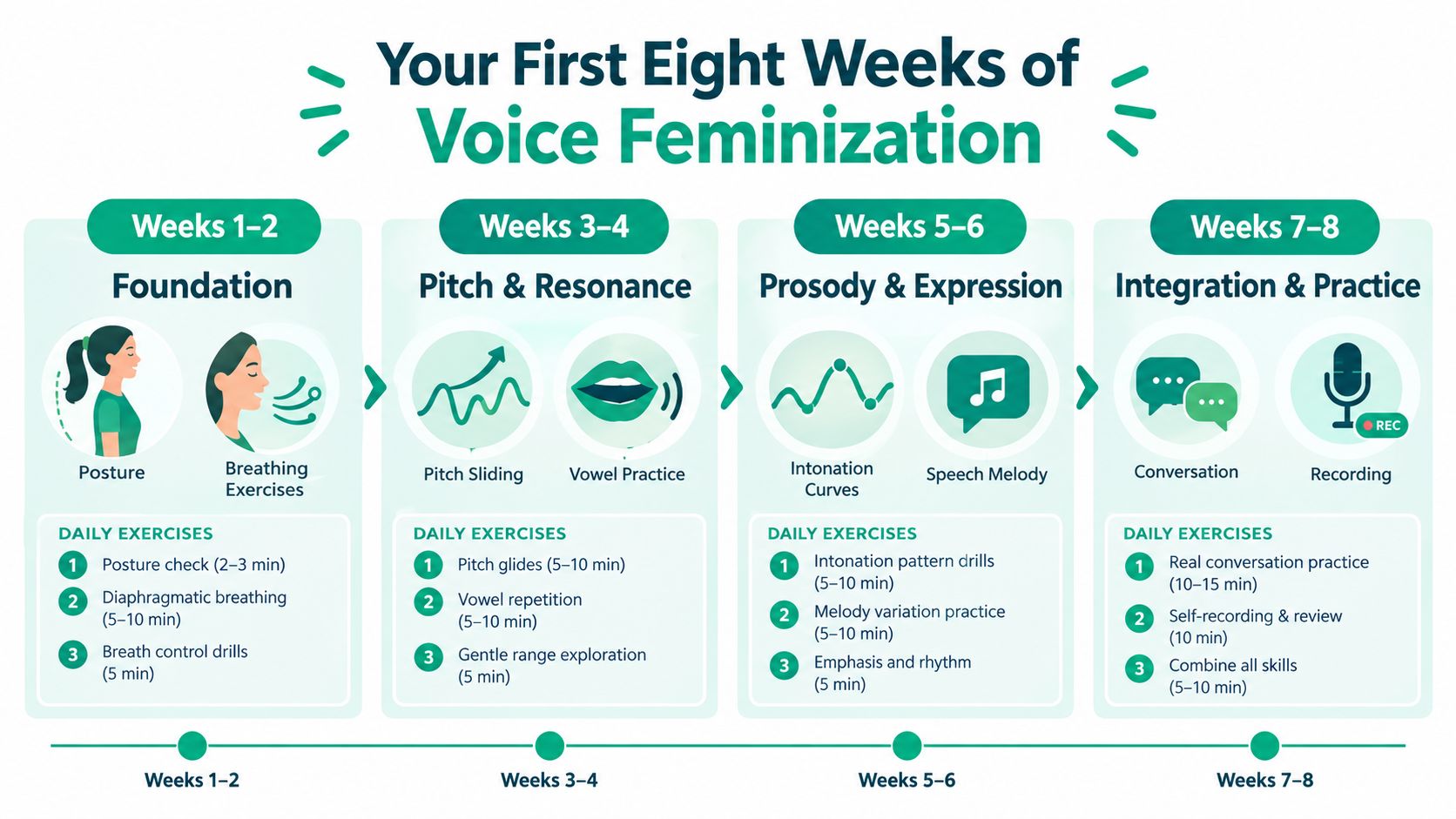
A manageable plan should build coordination before demanding performance. Practice consistently, stop when you feel pain or persistent strain, and treat the checkpoints as observations rather than tests you can fail.
Spend a short daily session on posture resets, lower-rib breathing, jaw release, and gentle humming. Explore larynx movement without holding it in a forced position. Your checkpoint is simple: you should be able to produce easy sound with less visible shoulder tension and no need to push the throat.
Introduce comfortable pitch glides, then practice “ma,” “ni,” “ee,” and “oo” while looking for a brighter oral sensation. Work toward a conversational region of 165 to 220 Hz, but don't sacrifice ease to reach it. Record short samples at the end of practice and label them by task, such as sustained vowel, reading, or spontaneous speech.
Practice written inflection arrows, wider but controlled phrase contours, lighter consonants, soft vowel onsets, and read-then-paraphrase pairs. Your checkpoint is whether the features remain present when you stop looking at the text. If the voice collapses during paraphrase, reduce the complexity and repeat the earlier resonance work.
Rehearse situations you face: a voicemail greeting, ordering coffee, introducing yourself, answering a routine question, or speaking with a friend. Keep the first attempts brief, then extend the conversation as comfort allows. Listen for stability across the full range, not just the highest moment.
At the end of the plan, compare your early and later recordings for comfort, resonance, prosody, articulation, consistency, and satisfaction. The 2025 meta-analysis found that therapy and surgical options improve pitch and quality of life, but the relationship between pitch change and quality of life was strong rather than perfect, with r² = 0.83, as reported in the meta-analysis indexed by PubMed. That finding reinforces the central principle: practical feminization depends on what survives conversation, not only what appears in a pitch reading.
Start tomorrow with the posture reset, breathing, and easy humming. Add pitch and resonance only when the foundation feels comfortable, then bring the changes into ordinary speech before judging whether they're working. Your voice doesn't need to match someone else's version of femininity. It needs to feel sustainable, expressive, and aligned with you.
Rooy Development can help you turn voice-feminization research, exercises, and practice notes into personalized listening material with curated sources and natural two-host audio. Visit Rooy Development to create a recurring study or coaching feed that supports consistent practice while you build conversational carryover.
Transform your content into engaging podcasts in seconds with our AI-powered platform.
Get Started Now