Podcast Name Check: A 2026 Guide to Verify Availability
podcast name checkpodcast namingpodcast trademarkdomain availabilitypodcast branding
17 min read
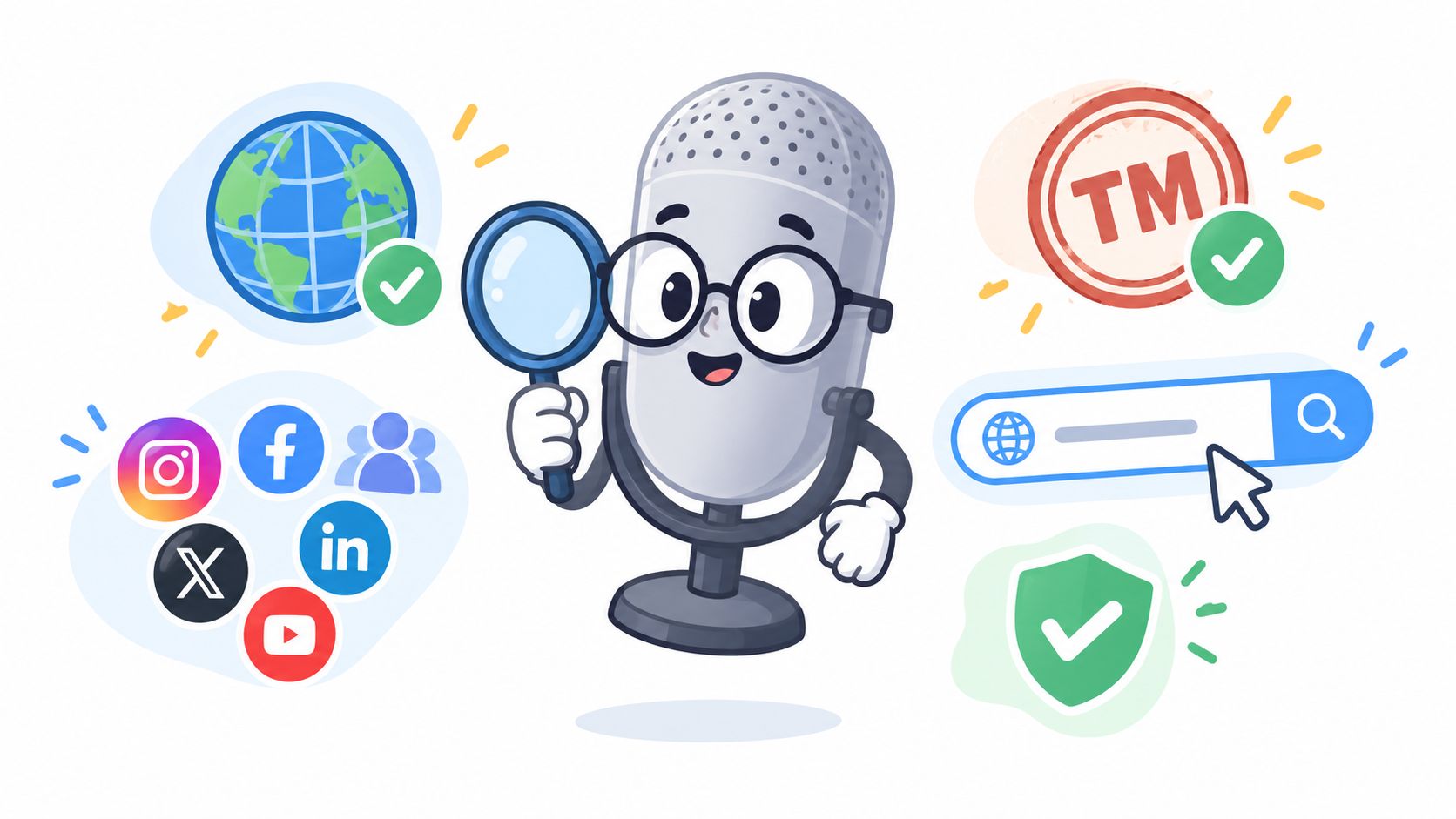
You've got a name you love. It sounds sharp when you say it aloud, looks good on cover art, and feels ready to publish. Then you search Apple Podcasts and find a dormant show with the same title. Google reveals a local media company using it. The matching domain is gone, and the social handle belongs to an account that hasn't posted in years.
That isn't a minor branding inconvenience. It's a warning that your podcast name check stopped too early. Podcasting has become a mainstream channel, with an estimated 672 million listeners in 2026, compared with 274 million in 2019, according to industry podcast statistics from SearchLab. A crowded audience also means a crowded catalog, so your title must survive directory searches, trademark review, social discovery, and word-of-mouth.
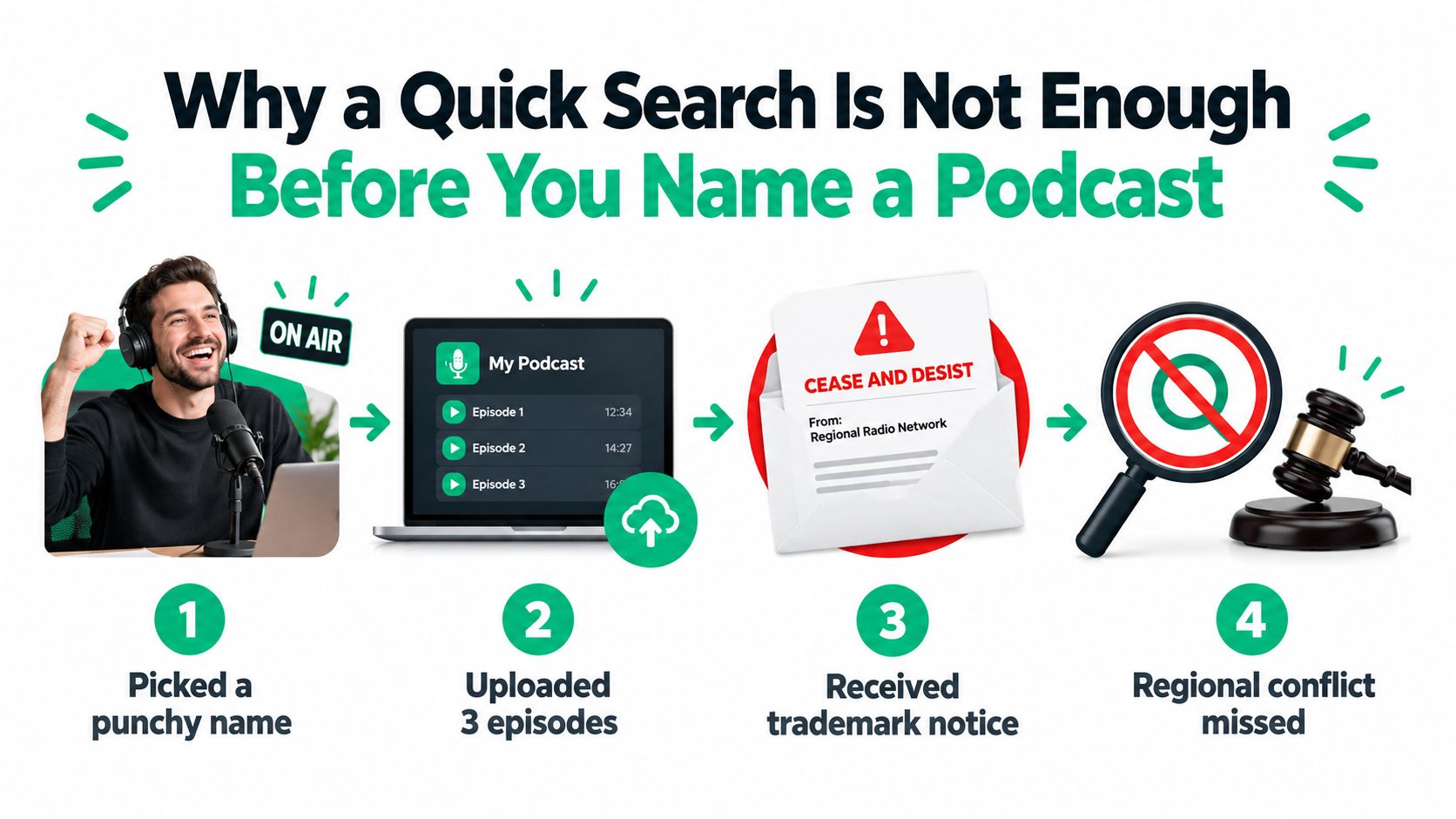
A creator can choose a memorable title, commission artwork, record a trailer, and announce a launch before discovering that another organization already uses the name. The scenario is easy to imagine: a new host finds a regional radio network with the same title only after publishing, then has to consider a rebrand, fresh artwork, revised audio, and confused listeners.
That's why I don't treat a podcast name check as a yes-or-no search. I treat it as risk reduction. A name can be absent from Apple Podcasts and still create trouble through an unregistered business use, a small directory listing, an old RSS feed, or a trademark covering related entertainment services.
Producer's rule: A name isn't clear because one search box returned no result.
A single Google search misses common-law use, alternate spellings, phonetic matches, translated versions, and results buried in directories you rarely use. A platform search can also produce false confidence when a dormant show has a different subtitle, a private feed isn't indexed clearly, or a title uses a visually similar character.
Run these checks before you spend on cover art, advertising, guest booking, or launch production:
The catalog itself is expanding quickly. One major source estimated nearly four million podcasts and more than 188 million episodes by April 2026, while other industry estimates cited in Statista's podcasting overview put the global title count and episode supply even higher. The exact estimates vary, but the practical conclusion doesn't: your title is competing inside a huge and constantly changing discovery environment.
Skipping a layer can cost more than the check would have taken. You may lose a handle, confuse listeners with another show, or rebuild a brand after launch. Do the work while changing the name is still cheap.
Start inside the directories where listeners are most likely to encounter your show. Search the exact title first, then search the meaningful words separately. If your idea is “Signal Garden,” try the full phrase, “Signal,” “Garden,” “Signals,” and likely combinations with your topic.
Don't stop at exact spelling. Search singular and plural forms, common typos, abbreviations, homophones, and words that sound alike when spoken. Check whether a host or network already uses the title as part of a broader show brand. A show with a different subtitle can still create confusion if its main title dominates the search result.
On Apple Podcasts, inspect the title, subtitle, author name, artwork, category, and recency of episodes. Spotify may surface related results differently, so search both the full phrase and individual terms. On YouTube Music, look for podcast channels, video versions, playlists, and accounts that use the title even when the RSS show itself isn't obvious.
Then expand beyond the major platforms. Pocket Casts, Overcast, Amazon Music, Listen Notes, and smaller regional directories can expose dormant feeds or older uses that a large platform doesn't show prominently. Search by the show title and, where available, by the RSS hosting provider or feed information.
| Platform | Search refinement | What to look for | False-negative risk |
|---|---|---|---|
| Apple Podcasts | Exact title, individual words, phonetic variants, subtitle terms | Active shows, dormant feeds, similar artwork, overlapping categories | Subtitle differences, punctuation, Unicode lookalikes |
| Spotify | Full phrase, partial phrase, host name, topic keyword | Related shows, network names, alternate title formats | Results ranked differently from Apple, incomplete title matching |
| YouTube Music | Title, channel name, video title, spoken variant | Video podcasts, channels, playlists, reused brand names | Show may appear as a video channel rather than a podcast listing |
| Pocket Casts and Overcast | Exact phrase, partial phrase, topic combinations | Older or independently hosted feeds | Smaller catalog interfaces and inconsistent indexing |
| Amazon Music | Exact title, host name, category terms | Duplicate titles, imported RSS feeds, regional uses | Delayed or incomplete directory updates |
If the exact name appears in two unrelated directories with active episodes, move on. Don't rationalize it because the other show is smaller or the artwork looks different. Listener confusion is still confusion, and a later dispute is harder to solve after you've built an audience.
For publishing workflow details, see this guide to publishing a podcast on Spotify, but don't confuse distribution setup with name clearance. A feed can be technically publishable and still be a poor brand choice.
Treat domains and social handles as one verification layer. Your podcast won't live only in an audio directory. It may have a website, YouTube channel, Instagram clips, TikTok excerpts, guest announcements, email newsletters, and sponsor pages. A name that works in one place but fails everywhere else creates avoidable friction.
Check the exact-match .com first. If it's unavailable, assess alternatives such as .co, .show, .fm, or .podcast. A clean alternative domain can work, but only when the podcast name itself is distinctive enough to carry branded search. I'd rather launch with a memorable name on a sensible alternative extension than force a weak title just to obtain an exact .com.
Test these variations:
brandnamebrandnamepod or brandnameshowlistenbrandname or a host-and-show combinationAvoid a long string of prefixes, numbers, or underscores. They make the handle harder to dictate, remember, and display. Hyphens can help a domain read clearly, but they add another detail listeners must remember. The same rule applies to handles, where consistency matters more than clever formatting.
Search Instagram, TikTok, YouTube, X, Threads, Bluesky, and Mastodon. Namechk and HandleChecker can speed up a broad social sweep, while Namecheap, Porkbun, and Instant Domain Search can help compare domain options. Treat tool results as leads, not legal clearance. A tool can tell you that an asset appears available, but it can't tell you whether the name is safe to use commercially.
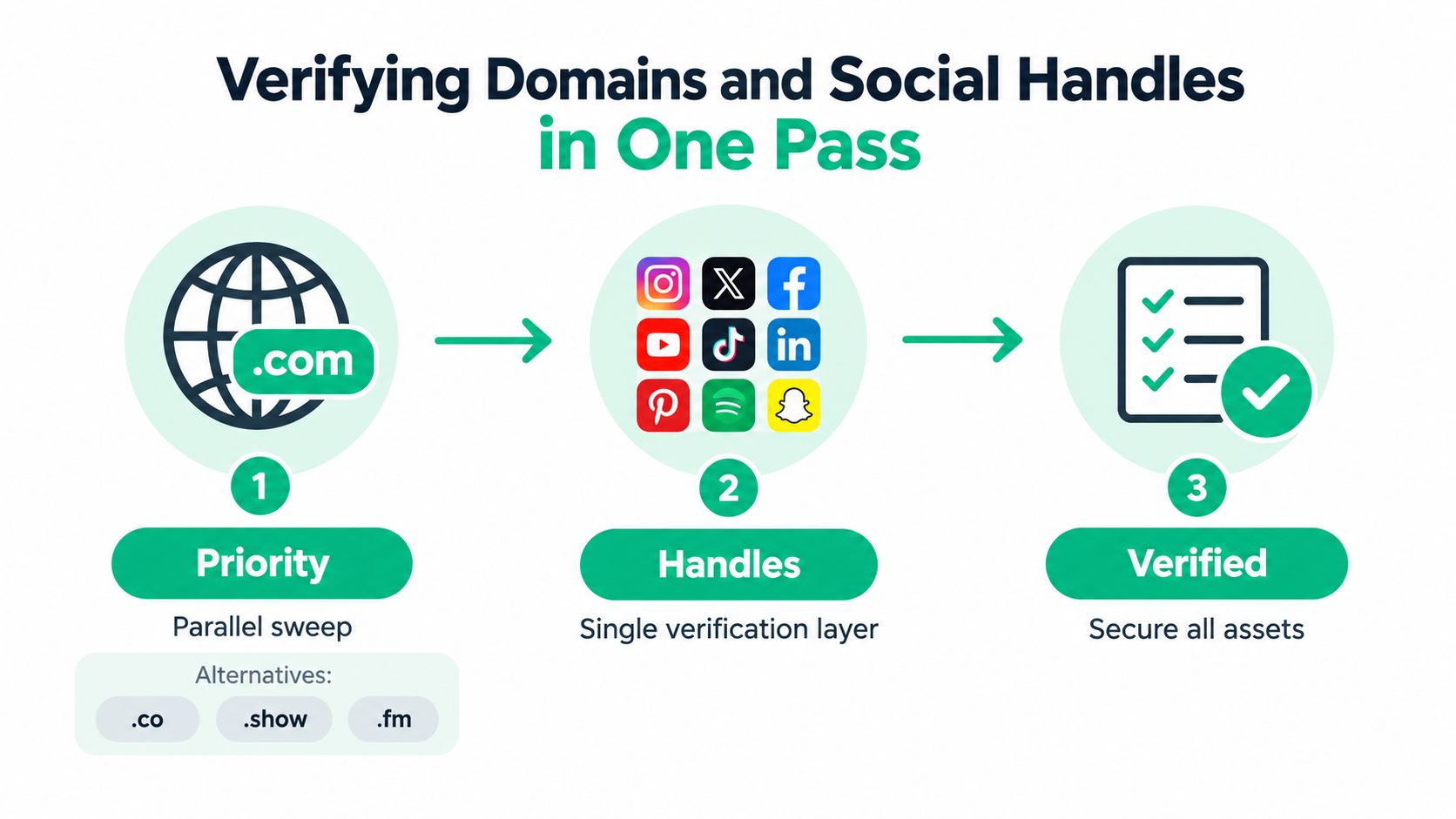
Buy the domain and claim the important handles in the same sitting if the name survives your search. Don't wait until launch week. A dormant handle may become unavailable, and a domain that looked unimportant during brainstorming can become central once guests, sponsors, and listeners start sharing the show.
My honest threshold is simple: launch without the .com only when the name is distinctive, easy to spell, and strong enough to win branded search. If the title is generic, losing the .com makes the discovery problem worse. If the title is ownable and memorable, a sensible alternative can be perfectly workable.
A platform search answers one question: does a visible show already use this title? A trademark search asks a harder question: could your use of this title create confusion with an existing brand?
Start with the official USPTO trademark database. Search the exact wording, then search the important words separately. Add phonetic equivalents, alternate spellings, plural forms, and marks that sound similar when spoken. The relevant service area often includes Class 41, which covers entertainment services, but Class 9 may matter when the broader brand involves downloadable media, software, or related digital products. Other classes can become relevant if you plan to sell merchandise, publish books, or build software.
The USPTO trademark database is an essential starting point, not a final legal opinion. A clean result means you didn't find an obvious federal registration in your search. It does not prove that another party has no rights.
A title can be available on Apple Podcasts and still be used by a regional broadcaster, education company, newsletter, event series, or independent creator. Unregistered use can matter, especially when the other party has used the name commercially in a related field.
A practical clearance workflow should include:
The distinction matters because a dead mark isn't automatically irrelevant. You need to understand whether the owner still uses the name, whether a related entity operates under it, and whether the old filing indicates a broader commercial history.
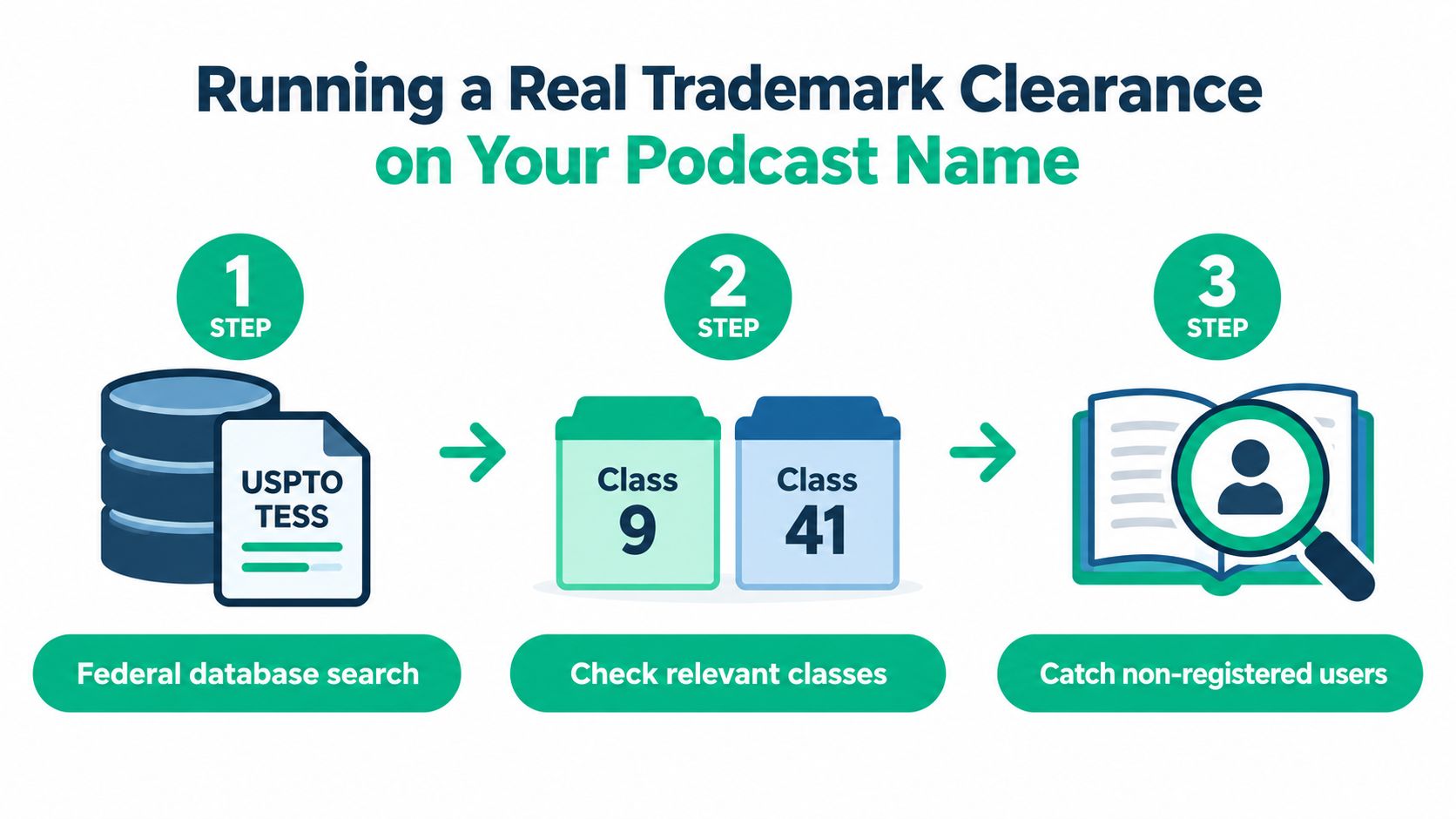
A creator handling a low-risk, narrowly scoped show can often complete a strong preliminary search without hiring counsel. A title that overlaps with an active entertainment, education, software, or media brand deserves professional review. International producers should also search the WIPO Global Brand Database, particularly when the show will operate across several markets.
Legal reality: A clean federal search is evidence of research. It isn't a promise that nobody can challenge your use.
If you're unsure how to protect the identity after clearance, this practical resource on how to protect your brand name explains the broader trademark considerations. Use it as background, then get advice matched to your actual title, owner, services, and markets.
A name can be legally usable and still be a terrible discovery asset. Generic titles blend into crowded results, while overloaded titles become difficult to remember and awkward to recommend.
One dataset-driven naming guide reports that 90% of podcast names avoid terms such as “podcast,” “pod,” or “talk,” 71% are three or four words long, and 82% use a balanced sound profile in its analysis of podcast naming patterns. See the podcast naming data from Namify. These figures aren't a formula, but they support a useful direction: don't add “podcast” merely because you think the title needs to explain the format.
Put each candidate into Google Trends and compare it with nearby phrases. Search Google autocomplete, then inspect the results page for unrelated brands, definitions, news stories, and dominant organizations. On Apple Podcasts and Spotify, check how the title renders in search, whether it truncates, and whether the main topic is obvious without opening the description.
Use Ahrefs or Keywords Everywhere to understand the competitive environment around the phrase. You're not trying to force a high-volume keyword into the title. You're checking whether the name is so generic that your show will disappear among unrelated results.
A strong option usually has one of three qualities:
Pronunciation deserves its own test. Leave the candidate as a voicemail, say it to someone who hasn't seen it written, and ask them to spell it back. If they produce several unrelated spellings, the name will leak referrals through word-of-mouth.
| Attribute | What to test | Pass threshold |
|---|---|---|
| Distinctiveness | Search results, directory matches, brand collisions | The title has a clear identity and limited confusion |
| Topic clarity | First impression without artwork or description | A listener can infer the subject or audience |
| Memorability | Recall after a short conversation | The listener remembers the core wording |
| Pronunciation | Spoken title and spelling response | Most listeners can reproduce it naturally |
| Display quality | Mobile thumbnail, directory listing, social profile | The visible title stays readable |
| Expansion room | Future guests, formats, products, or topics | The name doesn't trap the show in a narrow promise |
Short, coined, or unusual names often claim more search real estate than broad descriptive phrases, but don't choose obscurity for its own sake. A distinctive phoneme, uncommon word pairing, or strong image can help. The name still needs to sound credible when a guest introduces it and clear when a listener recommends it.
Your search log is cheap insurance. Create a spreadsheet or Notion page with columns for the date, exact term searched, platform or database, result, result URL, ownership notes, and screenshot path. Record both positive and negative findings. A blank result without a date is weak evidence because platforms and registrations change.
Use a consistent folder structure, such as the show name followed by the search date and platform. Save screenshots with descriptive filenames that identify the query and result. For example, a file can record the platform, search term, and whether the result was an exact match or a phonetic match.
A practical log might include:
This record helps when a lawyer asks what you searched, when a co-host leaves, or when a sponsor wants evidence that the brand received basic due diligence. It also protects your own memory. After weeks of brainstorming, creators forget which variations they rejected and why.
Cheap insurance: Document the search while the evidence is visible, not after someone challenges the name.
Re-run the check during the pre-launch period, especially if the title has become public. The best practices for knowledge management apply here because the goal is simple retrieval. Anyone on the team should be able to open the log and understand the decision without asking the original researcher to reconstruct it.
Don't rely on the argument that nobody will ever ask. A handle can disappear, a similar show can launch, or a co-host can dispute who approved the brand. A dated record won't eliminate every risk, but it gives you a defensible account of the work you performed.
Your search should end in a decision, not an endless research loop. Sort the result into one of three categories: clear enough to proceed, blocked by a meaningful conflict, or ambiguous enough to require escalation.
Move quickly and secure the whole identity:
The sequence matters because a name can become harder to claim once your public launch attracts attention. Don't announce the title for weeks while leaving every digital asset unclaimed.
Separate a hard conflict from a soft one. A live trademark for related entertainment services, an active show with the same title and overlapping subject, or a strong business using the name should usually end the discussion.
A dormant feed or abandoned social handle is different. It may still create confusion, but it gives you room to alter the title rather than discard the concept. Add a meaningful qualifier, change the primary phrase, choose a stronger synonym, or build a more distinctive compound name. Changing only the domain extension won't solve a title collision in podcast search.
Escalate when the title is strategically important or commercially valuable. A short consultation with a trademark attorney who understands podcasting can clarify whether the other use is close enough to matter. For a serious launch, ask about a formal freedom-to-operate opinion and define the conditions that would trigger a rebrand.
Use the podcast name generator to produce alternatives when your first choice fails. Don't use generated ideas as a substitute for clearance. Use them to widen the candidate list, then run the same layered process on every finalist.
Your same-day action checklist is straightforward:
Make the decision before you commission expensive creative work. A strong title supports discovery, recommendations, and future brand extensions. A weak title keeps charging you for the shortcut long after launch.
Rooy Development offers an AI podcast workflow that turns selected websites, PDFs, notes, and YouTube channels into scheduled two-host episodes, with source tracking, MP3 delivery, and support for more than 40 languages. Visit Rooy Development to explore the tool, then run a proper podcast name check before you publish the first episode.
Transform your content into engaging podcasts in seconds with our AI-powered platform.
Get Started Now