
AI Generated Podcast: Your Personal Audio Feed for 2026
ai generated podcastai podcastpodcast automationsynthetic audiotext to speech
15 min read
You've saved a dozen articles, bookmarked several videos, subscribed to newsletters, and still feel behind. The information isn't missing. Your available attention is. Reading requires a screen and uninterrupted focus, while useful audio can follow you through a commute, workout, or pile of dishes.
An AI-generated podcast turns that backlog into a personalized audio feed. Instead of searching for one more general-interest show, you can create episodes around your study materials, favorite websites, industry updates, or questions you want answered. The format is becoming a major part of the open podcast ecosystem. One 2026 tracking report found that roughly 35.4% of new podcast feeds were AI-generated, with about 485 new AI-generated podcast feeds appearing daily at the time of reporting, as documented by Gizmodo's coverage of the tracking report.

Your reading list probably contains a mixture of things that still matter and things you'll never open again. There's a technical article you intended to study, a newsletter about your industry, a long report from work, and a video someone recommended weeks ago. Each item competes for the same small block of quiet time.
An AI-generated podcast changes the question from “When will I read all of this?” to “What should I listen to next?” A system can gather selected sources, identify the useful ideas, turn them into a spoken script, and deliver the result through a private feed. You're still choosing what deserves your attention, but you're no longer limited to moments when your eyes are free.
Think of the experience as a robot DJ for your brain. A traditional podcast produces one episode for a broad audience. Your personal feed can focus on the topics, sources, depth, language, and schedule that suit you.
A student might receive an audio review built from lecture notes. A product manager might hear a recurring briefing based on selected company blogs and research pages. A curious traveler might ask for a digest about a destination before a trip. The feed becomes less like a channel you discover and more like a station you program.
Practical rule: Give the system a clear information diet. A focused list of trustworthy sources usually produces a more useful feed than an unlimited stream of random material.
This approach also makes audio a practical layer for information management. An audio digest app can help transform scattered reading into something you can consume while walking, cooking, or traveling, without pretending that listening replaces careful reading when the details matter.
The rapid growth of synthetic podcast publishing signals both opportunity and risk. More creators and services can produce audio quickly, but listeners need to distinguish between a personalized learning tool and a low-quality feed made only to fill directories.
An AI-generated podcast is an audio episode produced with software that handles some or all of the work usually done by a human production team. It can collect information, summarize documents, write a script, generate voices, add music or transitions, and publish the finished episode.
The format covers several uses. Some systems create fictional shows or automated news programs. Others turn a person's materials into a private audio briefing. That second format can reduce information overload by turning selected reading into a listening queue shaped around one person's needs.
A personal AI podcast has three moving parts: you set the topics, the system selects the material, and generated hosts deliver the episode.
This setup resembles a small production desk. You provide the assignment, the system sorts the research, and the voices present the result. The analogy helps explain why the output can change from one listener to another.
Traditional podcasting is mainly one-to-many. A host records an episode for a broad audience, and listeners receive the same version. Personalized generation supports one-to-one broadcasting, because an episode can reflect one listener's sources, questions, preferred length, and previous feedback.
The result still needs review. Generated audio may sound natural while including a weak summary, a missing context, or an inaccurate detail. The production model is flexible, though. You can create an episode from a prompt, document, web page, or recurring collection of sources instead of waiting for a host to address one specific question.
The finished audio may feature two hosts discussing a subject, but the actual product is the workflow behind their voices. The system must choose what belongs in the episode, explain unfamiliar terms, arrange ideas clearly, and show where the information came from.
A useful AI-powered podcast combines the roles of editor, researcher, scriptwriter, and audio producer. Its quality depends on how carefully each role is configured and checked.
A good AI podcast begins long before a voice starts speaking. The system needs to make sensible choices about sources, structure, delivery, and listening context. You can understand the complete process as four connected stages.
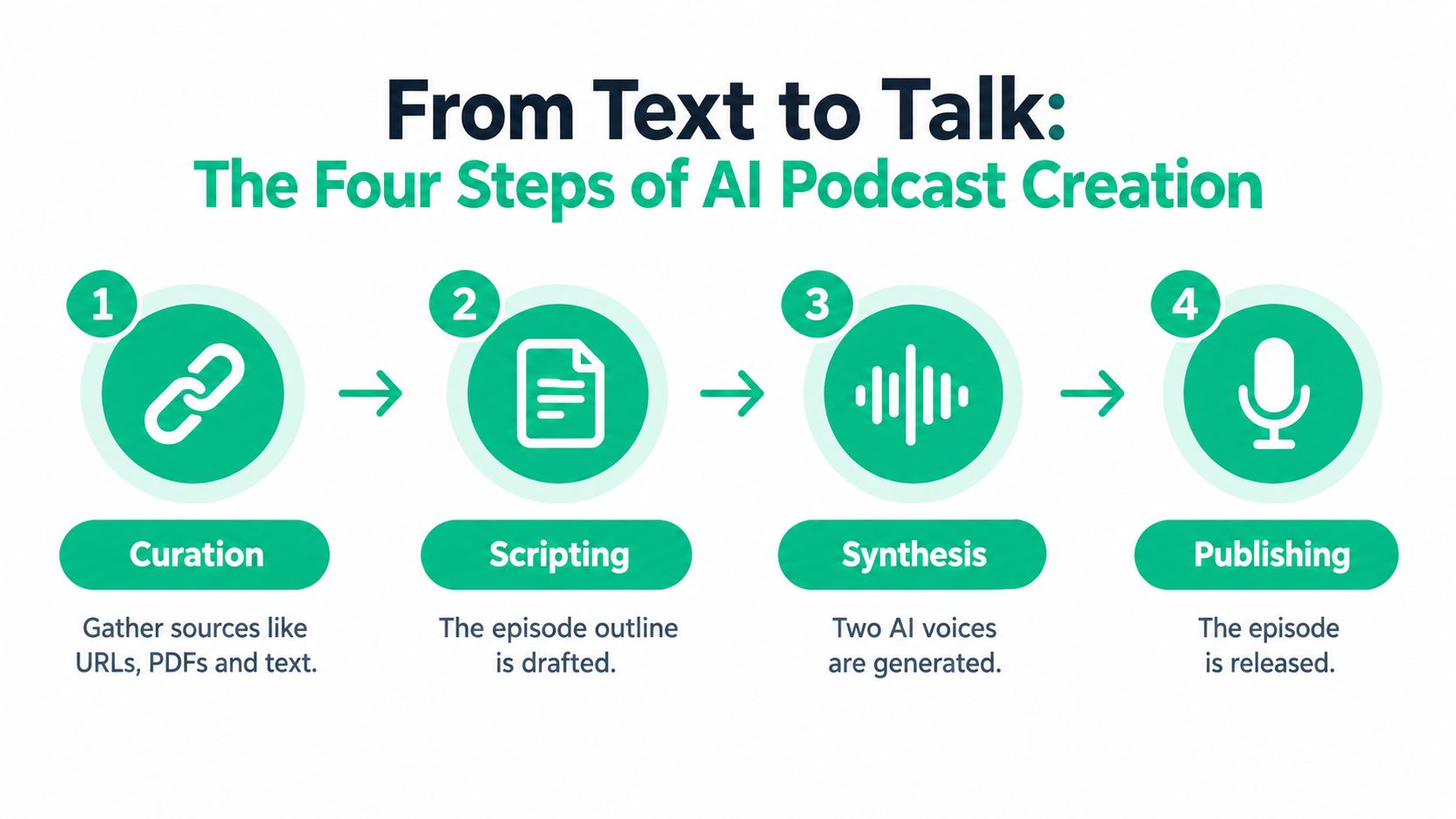
First, the system collects the content that will inform an episode. Depending on the service, that might include:
Curation is more than dumping everything into a folder. A useful system filters material according to the purpose of the feed. An exam-preparation series should prioritize the student's notes and assigned readings. An industry briefing should separate current updates from evergreen background information.
Source selection also affects trust. If the input contains outdated, promotional, or contradictory material, the resulting episode may sound polished while preserving those weaknesses. Treat the source list as the editorial foundation of your personal station.
Raw information rarely makes a good conversation. A script needs an opening, a logical sequence, explanations for technical terms, and transitions that help listeners follow the thread without a screen.
Two-host dialogue can make dense material easier to track. One voice might introduce a concept, while the other asks for clarification or supplies an example. That exchange gives the listener mental landmarks. It also helps prevent the flat, uninterrupted delivery associated with a basic screen reader.
Clear instructions matter here. Tell the system whether you want a quick overview, a revision lesson, a debate, a glossary, or a practical briefing. If you're developing a broader content workflow, these AI writing strategies for growth leaders can provide useful context for shaping prompts and editorial goals.
Voice synthesis creates the spoken track, but realistic audio requires more than pronouncing each sentence correctly. The voices need to vary emphasis, pause at sensible points, respond naturally to one another, and adjust their energy to the subject.
A technical explanation may need calm, deliberate pacing. A recap of a lively event may benefit from more expressive delivery. Questions, interruptions, laughter, and emphasis all influence whether the exchange feels like a conversation or like two machines taking turns reading paragraphs.
Prosody is the technical term for much of this expressive layer. It includes rhythm, stress, pitch movement, and timing. Systems can also struggle with names, foreign words, dialects, emotional shifts, and complicated sentence structures. Those problems may not appear in the written script, which is why listening tests remain essential.
The final stage delivers the episode where you'll use it. Some services create MP3 files, while others provide private podcast feeds that work with compatible listening apps. Scheduling can turn a one-time summary into a recurring briefing.
A strong workflow also includes feedback. If you skip episodes that repeat background information, the system should learn to reduce repetition. If you prefer deeper explanations, your instructions or ratings should help future scripts adjust their scope.
Long-form generation needs separate quality gates. The open podcast evaluation framework describes text, speech, and audio as distinct dimensions, because a script can be coherent while the delivery sounds unnatural, or the voices can sound convincing while the recording contains audio problems. Before trusting a feed, check all three layers:
A system that passes only one of these tests is not ready to become your daily information companion. For practical production, create a podcast with AI by setting the source boundaries and listening requirements before you automate delivery.
The value becomes clear when the feed solves a specific problem. Different listeners need different kinds of automation, but the pattern stays consistent: gather material that already matters, convert it into a useful explanation, and deliver it at a time when audio fits.
A student preparing for an exam could add lecture notes, assigned readings, and personal questions to a study series. Instead of rereading the same material in the same format, the student hears a structured explanation during a walk or on the way to class.
The best use is active recall, not passive background noise. Ask the system to explain a concept, pause for a question, compare two theories, or end with a short review. Then check difficult answers against the original notes. Audio can reinforce a study plan, but it shouldn't become the only source of truth.
A busy professional may follow company blogs, specialist publications, newsletters, and selected video channels. A recurring briefing can bring those updates into one place, separating major developments from minor announcements.
The listener can request a specific angle, such as “explain what changed and why it matters for a small software team.” That instruction turns a generic summary into a useful decision aid. It also reduces the friction of opening every source individually.
The feed can be especially helpful when information lives in mixed formats. A PDF report, web article, meeting note, and video transcript can become parts of the same listening routine. If you're publishing a conventional show as well, it's sensible to compare Transistor podcast plans before choosing hosting and distribution tools, because a public podcast and a private personalized feed serve different purposes.
Here's a short visual example of how an AI podcast workflow can fit into a broader content process:
A newsletter writer, educator, or content team can turn existing material into audio digests. The source remains the original article, lesson, or update, while the generated episode offers another way for the audience to engage.
Creators still need editorial approval. They should decide which passages deserve emphasis, remove sensitive information, verify summaries, and disclose that voices or scripts were generated. Automation can make repurposing easier, but the creator remains responsible for clarity and accuracy.
Personalized audio is powerful because it fits around the listener rather than forcing the listener to reorganize the day. It can reduce the effort needed to begin learning, make complex material easier to revisit, and create continuity between disconnected sources.
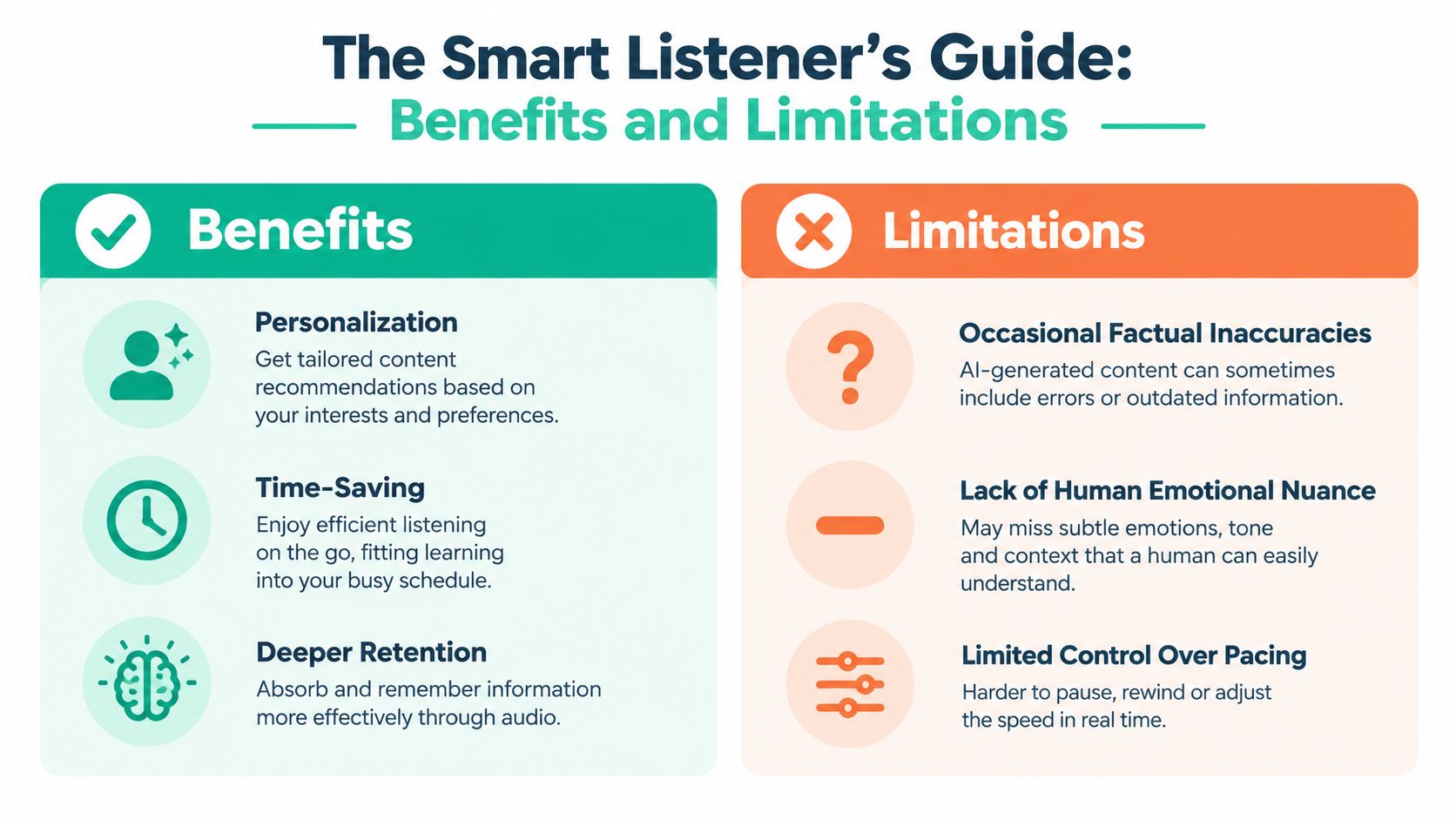
| Benefits | Limitations |
|---|---|
| Personalization: Episodes can follow your topics, sources, language, and preferred depth. | Accuracy risk: A fluent voice can present an incomplete or incorrect summary. |
| Convenience: You can listen while doing tasks that don't require visual attention. | Human nuance: Synthetic hosts may miss the spontaneity and emotional complexity of a live conversation. |
| Repetition: You can revisit explanations in a format that supports auditory learning. | Pacing control: The generated rhythm may not suit every listener or subject. |
Personalization is the biggest difference from ordinary podcast discovery. You can narrow the subject, request a certain level of explanation, and build a feed around materials you already trust. That makes the technology useful for niche questions that broad shows may never address.
Audio also improves access for people who find long reading sessions tiring or difficult. Native-language narration can lower the effort required to understand unfamiliar material, although listeners should still evaluate pronunciation and translation quality for specialized terms.
The format encourages regular contact with a topic. A short recurring briefing may keep an industry, course, or hobby present in your mind without requiring a separate research session every time.
An AI-generated podcast can sound confident even when its source material is weak. Summaries may omit context, merge ideas that should remain separate, or fail to distinguish established information from speculation. Critical medical, legal, financial, academic, or workplace decisions require direct review of the original sources.
The format also lacks some qualities that make human podcasts memorable. A live host can react to an unexpected answer, reveal personal experience, change direction, or create a surprising connection. Synthetic dialogue can be smooth without possessing that lived perspective.
Listening habit: Use generated audio to understand, review, and discover. Open the original source before you act on an important claim.
Treat the voice as an interface, not as evidence. The episode's usefulness comes from the quality of its sources, reasoning, and editorial checks.
The convenience of automated audio creates a responsibility for both producers and listeners. A system can transform information quickly, but speed makes weak sourcing easier to scale. Listeners need to know what material informed an episode, when that material was collected, and whether the audio is synthetic.
Moderation systems are already responding to low-quality and deceptive publishing. A 2026 summary reported that Listen Notes removed 60,277 AI-generated fake podcasts during the 12 months from September 2025 through August 2026, illustrating the scale of the challenge in its summary of podcast industry data. The lesson isn't that all generated audio is harmful. It's that open platforms need stronger distinctions between useful automation, spam, impersonation, and fabricated content.
The most productive mindset treats an AI podcast as a personal learning assistant, not an unquestionable authority. It can turn information overload into a manageable listening habit, but your judgment still decides what deserves trust.
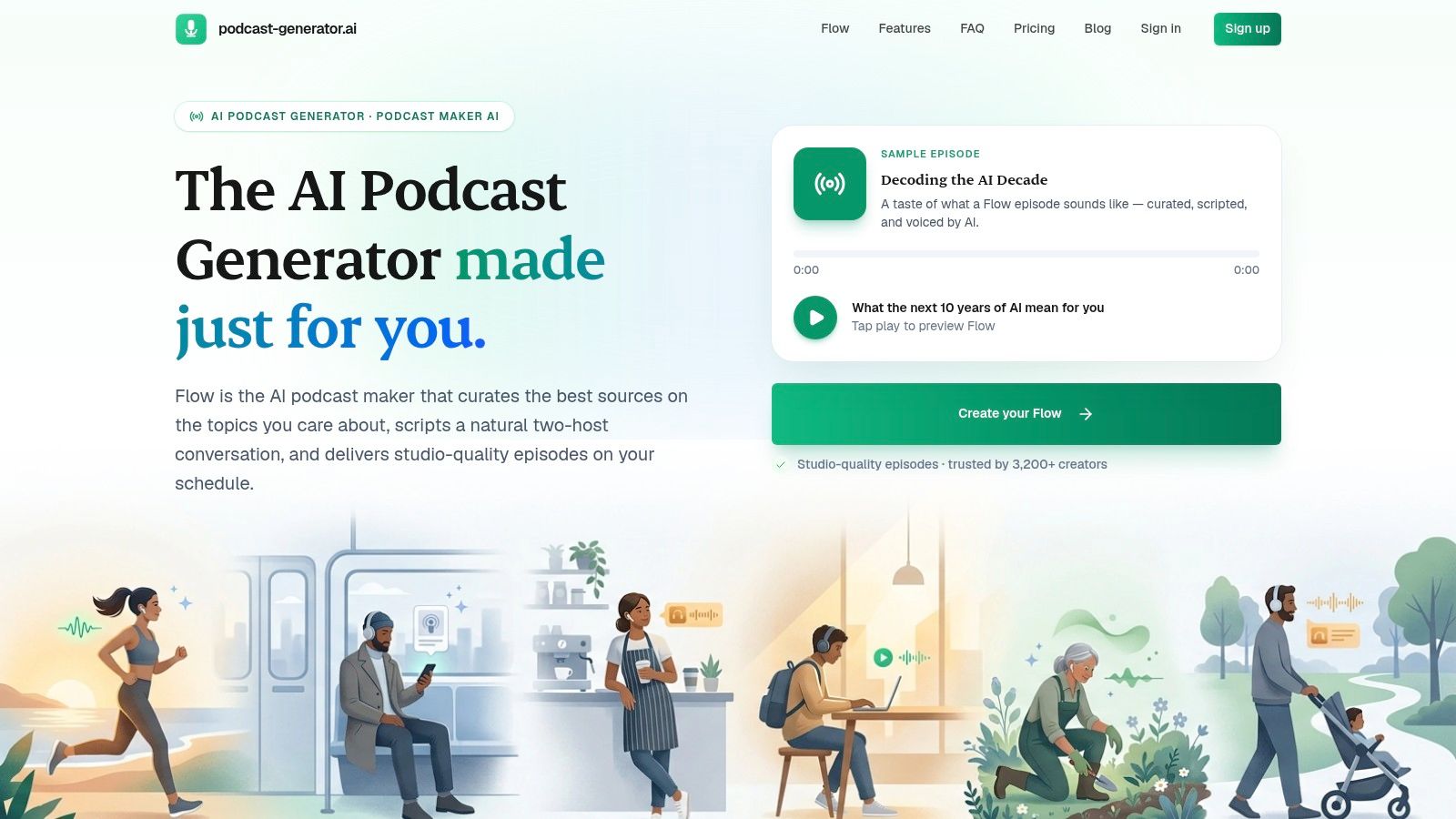
Rooy Development offers a service that turns selected topics, websites, PDFs, notes, and YouTube channels into personalized podcast episodes with two-host scripts, scheduled delivery, private feeds, and multilingual narration. Visit Rooy Development to create an audio feed for your coursework, industry briefing, or growing list of questions.
Transform your content into engaging podcasts in seconds with our AI-powered platform.
Get Started Now