
AI Podcast Guide: Create Personalized Audio in Minutes
ai podcastpodcast creationvoice synthesisaudio automationpersonalized content
16 min read
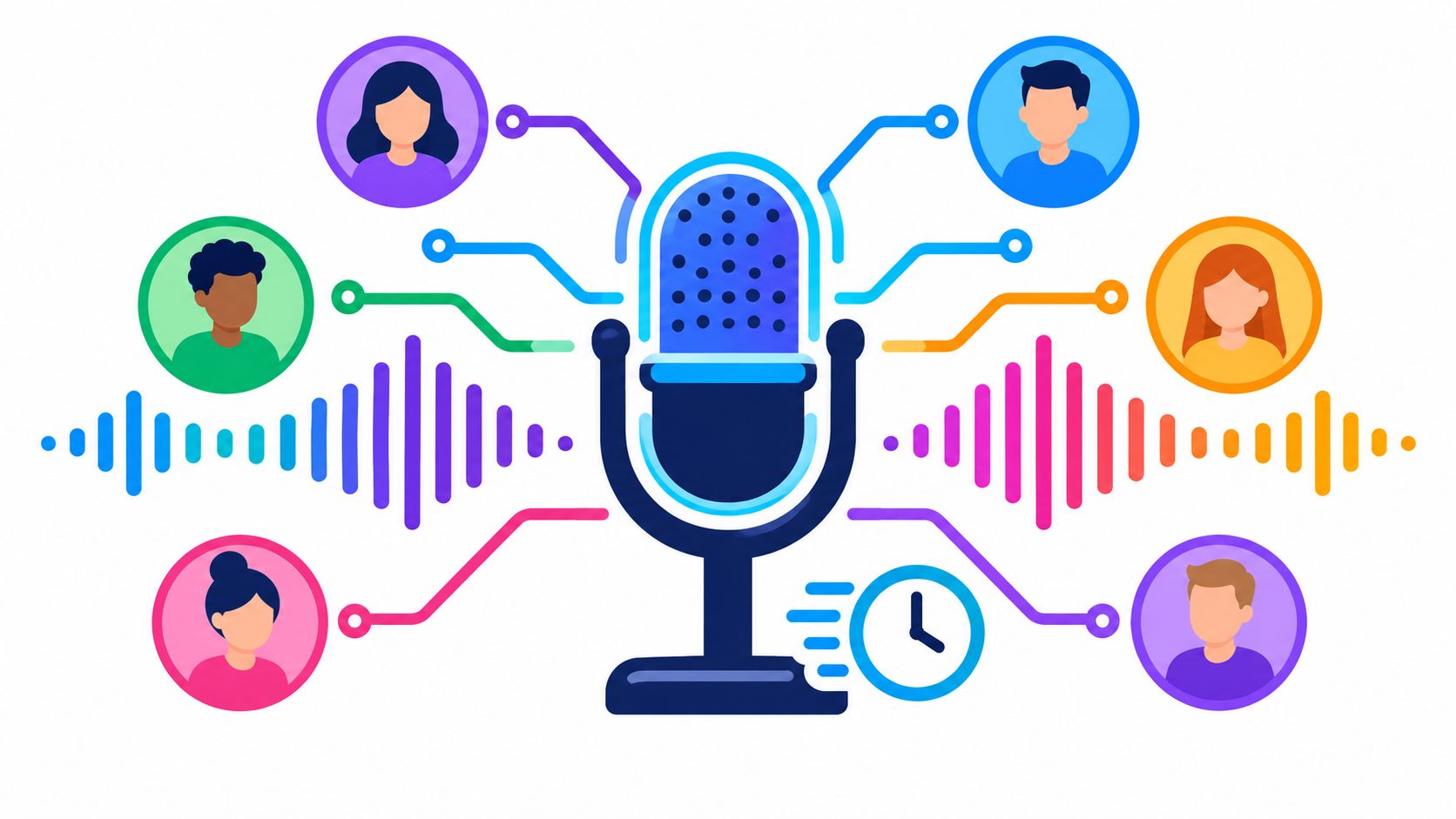
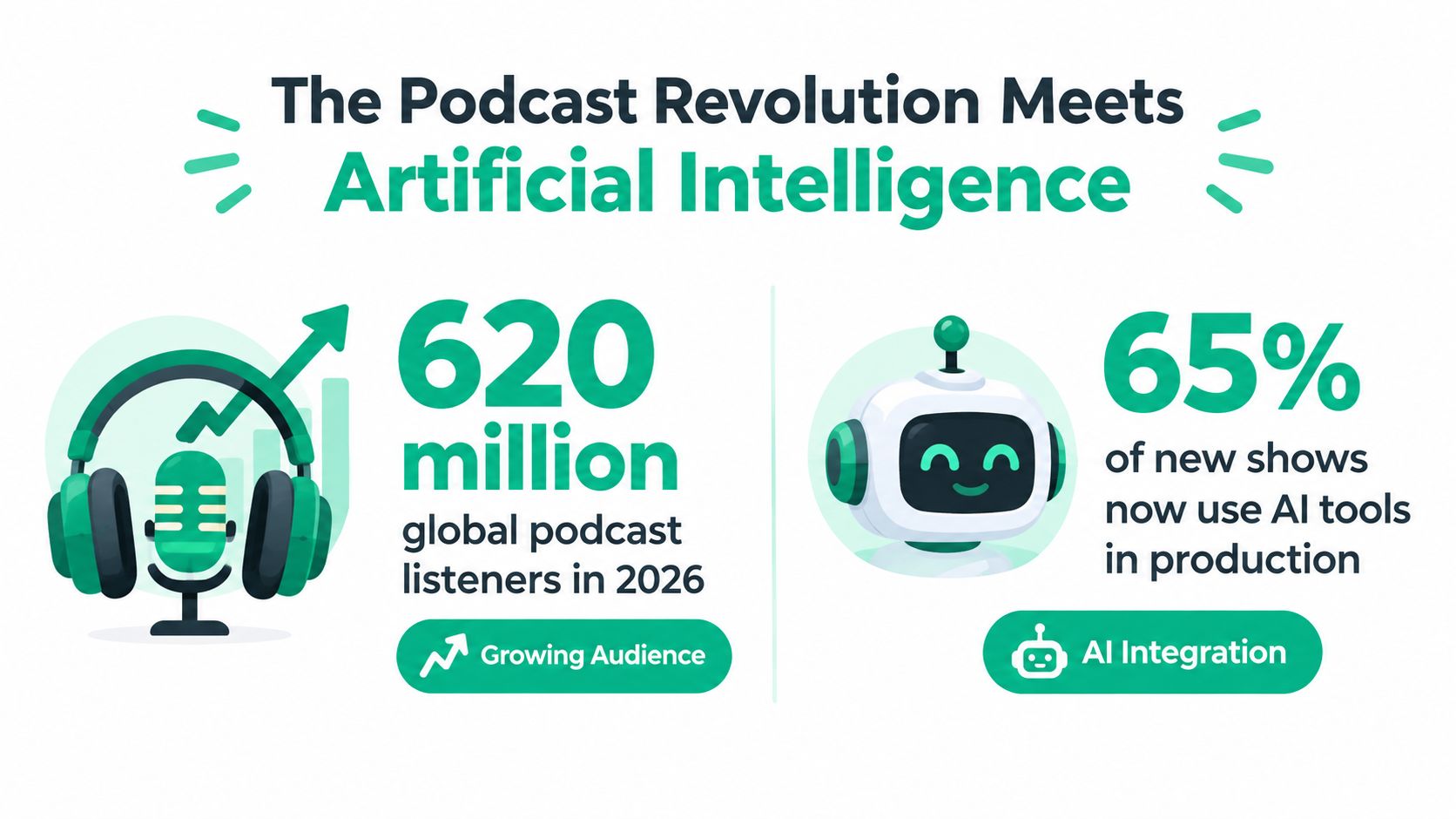
The surprising part of the AI podcast boom isn't that machines can produce human-sounding audio. It's that podcasting is expanding while production is becoming more automated at the same time. Global podcast listening reached about 619.2 million people in 2026, up from roughly 584.1 million in 2025 and 546.7 million in 2024, according to podcast industry statistics compiled by Search Engine Land. At the same time, industry reporting indicates that 34% of new podcasts use at least one AI production tool, while another estimate places creator adoption near 25% (Searchlab's 2026 podcast statistics).
That combination changes the question. AI isn't only helping people make another generic show. It can turn selected sources into recurring briefings, study episodes, language-specific explainers, and private audio feeds shaped by what each listener wants. The practical advantage comes from the complete workflow, from source selection to script review, voice rendering, and delivery.
AI podcasts turn audio from a fixed broadcast into a responsive information service. Podcasting continues to expand toward 651.7 million listeners in 2027, shifting the practical bottleneck from finding an audience to producing useful, targeted episodes at scale, as reported in Search Engine Land's podcast statistics guide. A small team can publish for a broad audience, but it cannot manually research, script, record, edit, and translate a separate briefing for every topic, schedule, and language.
An AI podcast addresses that capacity problem through an end-to-end workflow. You can select industry websites, upload course notes, add a YouTube channel, and request a conversational summary in a preferred language. The system then helps turn those materials into an episode shaped around one listener's sources and priorities, rather than distributing identical audio to everyone.
AI adoption is moving beyond playful experiments. The 2026 podcast statistics report from Searchlab describes roughly 4.58 million podcasts worldwide as of January 2026, while other 2026 estimates place the total near 4.7 million registered shows. In such a crowded field, automation can organize research, assist with scripting, edit recordings, prepare promotion, and adapt episodes for multiple languages.
The workflow still needs editorial direction. A creator must decide which sources deserve trust, what the audience needs to understand, and whether the finished episode represents the evidence accurately. AI handles repeatable preparation, leaving people more time for selection, interpretation, and review.
Practical rule: Use AI to reduce production friction, not to remove editorial responsibility.
Traditional podcasts usually create one episode for a broad audience. An AI podcast can instead produce a private briefing for a learner revising one subject, a professional monitoring one market, or a listener converting a reading queue into audio.
Script quality matters before voice generation. Narrareach's AI humanizer can help review stiff phrasing and improve conversational flow, so the spoken version sounds more natural. The larger opportunity is practical: podcasting can serve as both a publishing format and an adaptive interface for knowledge.
Think of an AI podcast like a restaurant. Your sources are the ingredients, the scripting engine is the chef, and voice synthesis is the service team that presents the meal in a chosen style and language. A good result depends on every stage. Fresh ingredients can't rescue a badly structured recipe, and a polished voice can't fix inaccurate content.
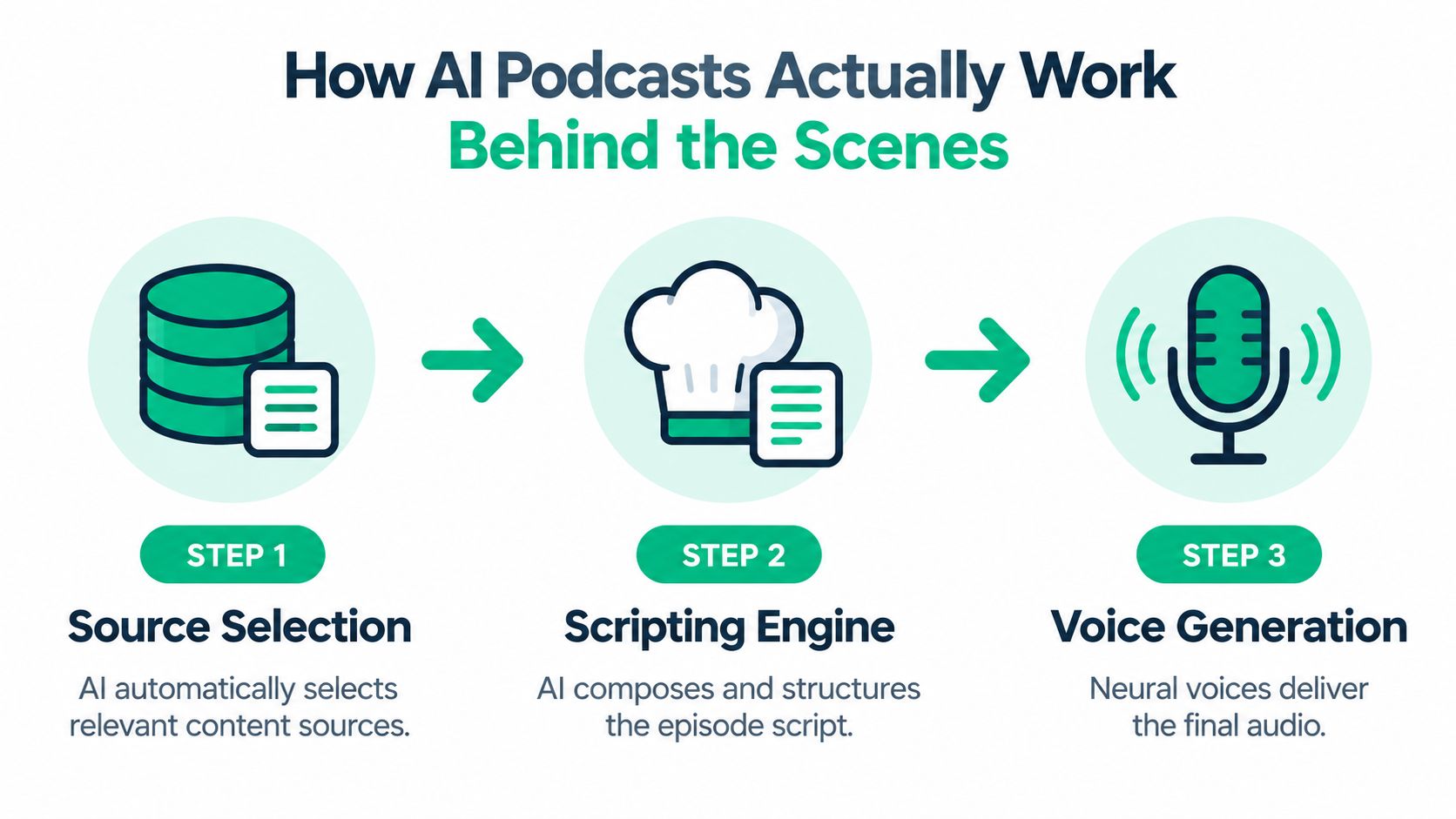
The system first gathers material. That might include webpages, PDFs, notes, prompts, or videos. It identifies relevant passages, removes material that doesn't match the topic, and creates a usable context window for the script. If the episode concerns a changing subject, a research-enabled workflow can also retrieve current information and preserve citations for review.
This stage determines the episode's factual foundation. A vague prompt such as “tell me about technology” produces a broad result. A defined topic paired with selected sources gives the system boundaries, priorities, and evidence.
The scripting engine turns that source material into an outline and then into dialogue. It decides what to introduce first, which ideas need explanation, where examples belong, and how two hosts can create a natural rhythm without repeating one another.
Research supports this separation of responsibilities. The 2025 ACL paper on PodAgent's multi-agent podcast generation framework separates content planning, voice-role matching, and speech synthesis. In its experiments, the system achieved 87.4% voice-matching accuracy and substantially outperformed direct GPT-4 generation on topic-discussion dialogue content. The lesson is practical: specialized stages can produce better results than asking one model to plan, write, cast, and perform everything at once.
The final stage converts the approved script into audio. A voice model handles pronunciation, pacing, pauses, emphasis, and emotional tone. The MoonCast and SoulX-Podcast research describes a two-step architecture in which an LLM creates the script and a long-context speech module generates the spoken output. That design separates meaning from acoustic performance, which makes the pipeline easier to control.
For a practical look at the editing stage, explore this guide to an AI podcast editor. The central idea is simple: source selection, script structure, and vocal delivery are different jobs, and each deserves its own quality check.
Creating an AI podcast episode feels simple at the surface because the complicated work happens inside the pipeline. You provide a direction, choose source material, set preferences, and review the result. Underneath, the system performs a sequence of editorial and audio decisions.
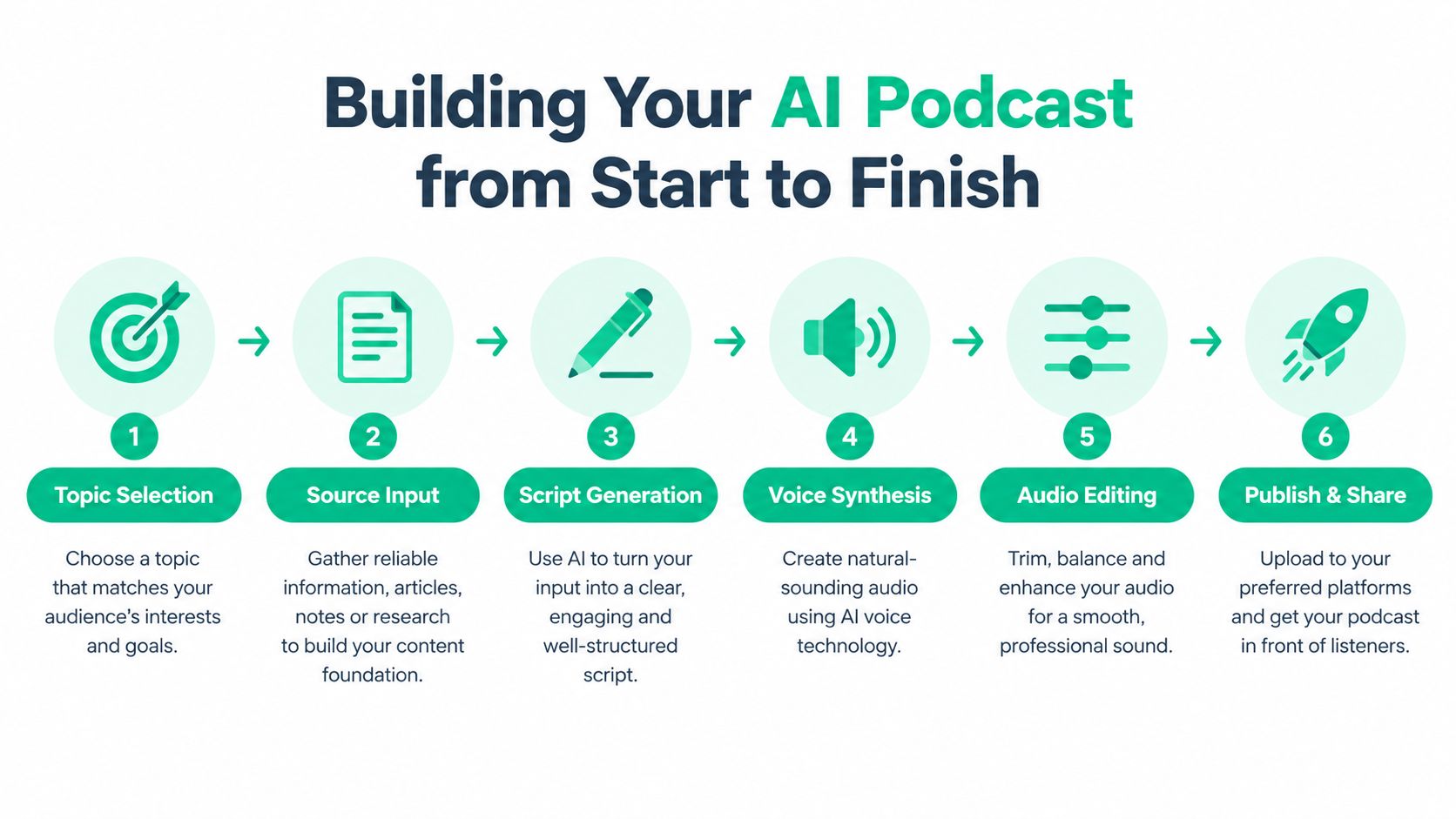
Choose the outcome before choosing the format. “Keep me informed about cybersecurity research” leads to a better series than “make a tech podcast.” You can define the audience, preferred depth, episode length, tone, and whether the hosts should explain terms or assume prior knowledge.
Then add sources. A useful workflow can combine a website, a PDF, personal notes, and a YouTube channel in one series. For script planning ideas, revid.ai's podcast script resources can help you think through openings, transitions, host roles, and closing summaries.
The system reviews the supplied material and identifies what belongs in the next episode. It can prioritize recent updates, detect new posts on subscribed sites, and organize scattered information around the topic. Source tracking matters for recurring series because you don't want every episode to repeat the same background.
A strong episode brief should answer three questions:
The script engine then creates a two-host conversation. One host might introduce the subject, while the other asks for clarification, challenges an assumption, or offers an example. This structure makes dense material easier to follow, but the dialogue still needs editorial review. Natural-sounding chatter can become distracting if every point receives a dramatic reaction.
You can also refine future episodes through feedback. Likes and skips help the system adjust source selection, tone, depth, and subject emphasis. That feedback loop turns a one-off generation tool into a listening routine.
Voice synthesis creates the audio with selected voices, pacing, pauses, and emotional inflection. Multilingual systems can produce native-sounding scripts and narration instead of just reading an English script with a translated label. After rendering, listen for mispronunciations, unsupported claims, awkward transitions, and missing context.
Finally, export the MP3 or deliver the episode through a private feed. A detailed overview of the workflow appears in this guide to creating a podcast with AI. The best process keeps a human review step before publication, especially when the subject is technical, sensitive, or time-dependent.
The value of AI podcasting isn't that every human-made show should disappear. Traditional production still offers distinctive host chemistry, reporting, performance, and creative control. AI becomes compelling when the objective is frequent, personalized, source-driven audio rather than a single polished production for a broad audience.
A manual episode often requires research, outlining, writing, recording, editing, mixing, and publishing. An AI workflow can compress those tasks into a faster sequence, while allowing one person to maintain several narrowly focused feeds. The trade-off is that speed comes with responsibility. You must inspect sources, correct errors, and decide where synthetic performance fits the audience.
| Dimension | Traditional Production | AI-Generated Podcasts |
|---|---|---|
| Research | Human-led research and note organization | Automated source gathering and curation with configured inputs |
| Scripting | Written manually or with editorial collaboration | Generated from topics, sources, preferences, and feedback |
| Voices | Requires hosts, studio time, and retakes | Synthetic voices with selectable delivery and pacing |
| Personalization | Usually one episode for a broad audience | Individual feeds can reflect different interests and sources |
| Languages | Translation and rerecording add separate work | Scripts and narration can be produced across supported languages |
| Consistency | Depends on schedules, energy, and available production time | Recurring generation follows preset preferences |
| Editorial control | Direct human control throughout | Faster creation, but human review remains essential |
| Authenticity | Human presence is immediate and distinctive | Voice disclosure and audience expectations require care |
AI-generated audio works especially well for repeatable information needs. A commuter may want a short industry briefing. A learner may want lecture notes converted into a review dialogue. A creator may want a private digest of newsletters and videos before deciding what deserves a public episode.
The weaker use case is content that depends entirely on lived experience, original interviews, investigative reporting, or a host's personal relationship with the audience. Those formats gain value from human presence that automation can't easily imitate.
The useful comparison isn't human versus machine. It's manual repetition versus intelligent assistance.
A medical student doesn't need another folder of lecture notes. She needs a way to revisit difficult concepts while walking between classes, cooking, or preparing for an exam. She can provide course PDFs and notes, ask for a structured study series, and have the system turn the material into short conversations that define terms, compare mechanisms, and revisit earlier ideas.
The result isn't a replacement for textbooks or clinical instruction. It's an additional route through the material. A spoken explanation can make review feel less repetitive, while a recurring sequence can keep related concepts connected instead of leaving them scattered across separate documents.
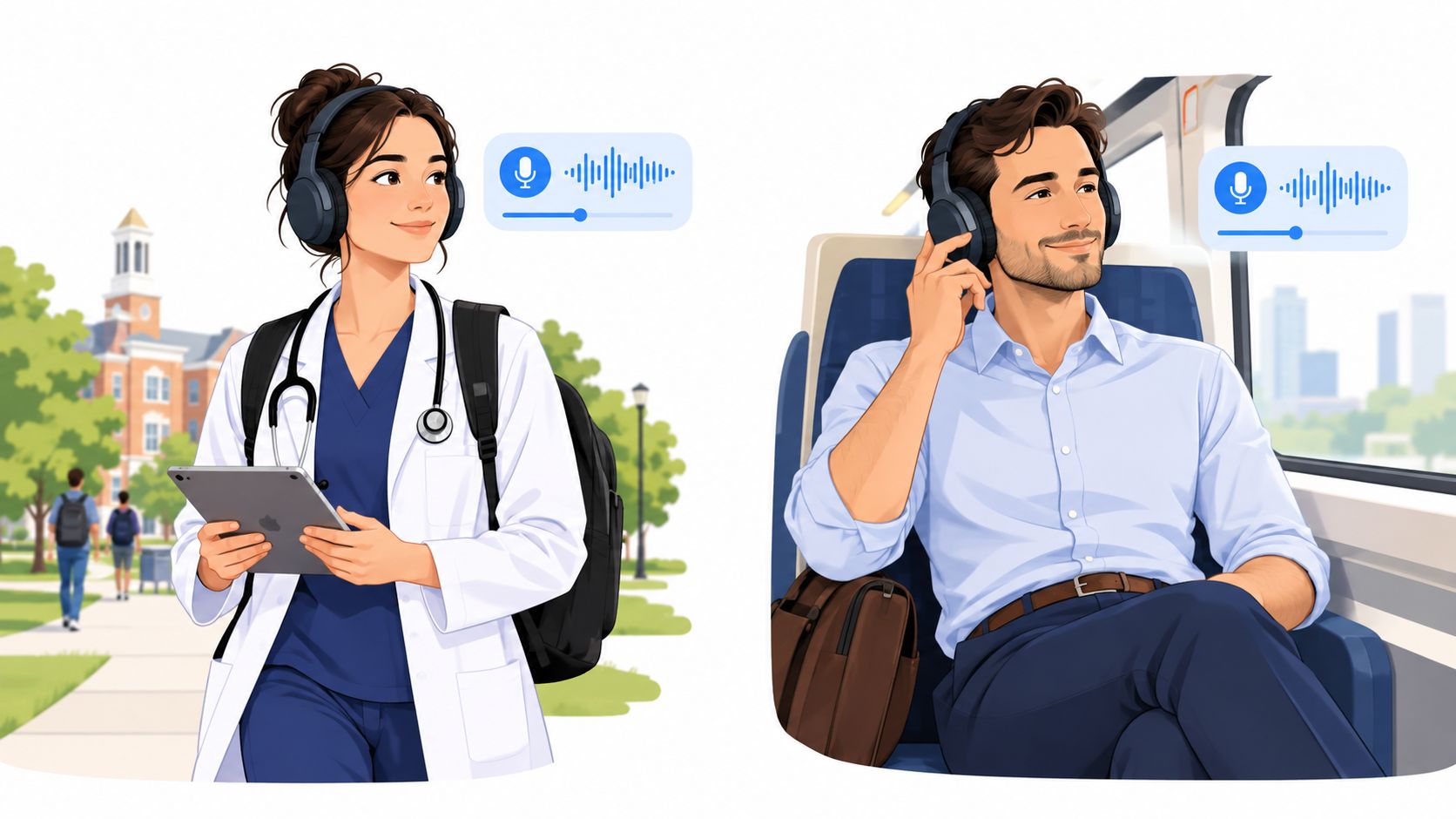
A product manager may follow company blogs, analyst commentary, newsletters, and YouTube interviews. Reading everything during the working day is unrealistic, so an AI podcast can consolidate those sources into a scheduled briefing. One host can summarize the development, while the second explains its relevance to product decisions or asks what remains uncertain.
The professional still needs to open the original source before making a consequential decision. The audio feed serves as an orientation layer, helping identify which items deserve closer attention.
A non-native English speaker may understand written material but process complex ideas more comfortably in another language. Native-language scripting and narration can reduce the effort required to follow unfamiliar vocabulary, especially when the episode explains rather than merely translates.
This approach also helps families, teams, and classrooms share one topic through different language experiences. The source material stays connected, while the delivery adapts to the listener.
These examples share the same practical pattern:
An AI podcast becomes useful when it fits an existing habit. The winning moment isn't the first impressive demo. It's the episode that arrives when the listener has time to use it.
A synthetic voice can sound confident even when its source material is incomplete. That creates a trust problem, especially in health, finance, education, and news. Listeners deserve clear disclosure when narration, hosts, or substantial scripting come from AI, because knowing how an episode was made helps them judge its authority.
This concern has moved beyond theory. An independent media-studies paper on trust and ethics in AI-narrated podcasts cites SSRS research indicating that 22% of U.S. weekly podcast consumers aged 13 and older have listened to a podcast narrated by an AI-generated voice. The figure shows that synthetic narration already reaches ordinary listeners. It also makes transparency a practical design requirement rather than a niche debate.
A light entertainment briefing may need a simple label that identifies AI narration. A medical study aid needs stronger safeguards, including source visibility, careful wording, and a reminder that the episode doesn't replace qualified instruction. A financial briefing should distinguish sourced facts from interpretation and signal when information may be outdated.
Use a visible disclosure in the feed description and an audible note when appropriate. Don't present an artificial host as a real person, and don't let a polished performance imply that every statement has been independently verified.
The Research Protocols study on AI-generated podcasts and reading describes promising educational uses, including conversational audio built from academic material. It also identifies unresolved questions around cognitive load, long-term retention, oversimplification, long-form coherence, cultural nuance, and user experience.
That distinction matters. A two-host exchange may improve motivation for some listeners, but conversational energy can also hide gaps in reasoning. Learners should receive definitions, examples, source references, and opportunities to return to the original text.
Treat a fluent voice as a delivery layer, not as proof.
Human oversight remains essential for source checking, sensitive claims, cultural context, pronunciation of specialist terms, and decisions about what the listener should not infer. Responsible AI podcasting isn't anti-automation. It uses automation with clear boundaries.
You don't need audio engineering knowledge to test the format. You need a topic you care about, source material worth understanding, and a willingness to review the first result critically. AI podcast systems are now capable of handling the full journey from source input to scripted dialogue and rendered audio, but the quality still depends on the clarity of your instructions and the reliability of your material.
Start with a small, useful series rather than an ambitious public show. A focused briefing or study feed gives you an immediate way to judge whether the episode is accurate, understandable, and convenient.
For source-based conversion, a text-to-podcast workflow can help you turn written material into an audio format without building a recording setup. Ask the hosts to explain unfamiliar terms, separate fact from interpretation, and end with a concise recap. If the subject affects health, money, grades, or professional decisions, verify important claims against the original sources.
An AI podcast is a strong fit when you need to:
Rooy Development's Flow service creates personalized podcast episodes from selected topics and sources, including websites, PDFs, notes, and YouTube channels, then can deliver MP3 files or private-feed episodes on a recurring schedule. It belongs in the category of tools that automate research organization, dialogue scripting, voice generation, and distribution, while leaving the listener responsible for checking important information.
The best time to try an AI podcast is when you already have a queue you can't finish. Choose one useful topic today, add a few trustworthy sources, generate a short episode, and judge it by what you remember and how easily you can verify it.
Rooy Development offers Flow, an AI podcast generator that turns your chosen topics and sources into personalized, scheduled audio episodes. Visit Rooy Development to create a focused briefing or study feed and explore a practical way to learn, monitor information, and reclaim listening time.
Transform your content into engaging podcasts in seconds with our AI-powered platform.
Get Started Now