Audio Digest App: What It Is and How It Works
audio digest appAI podcastspersonalized audiocontent curationvoice synthesis
17 min read
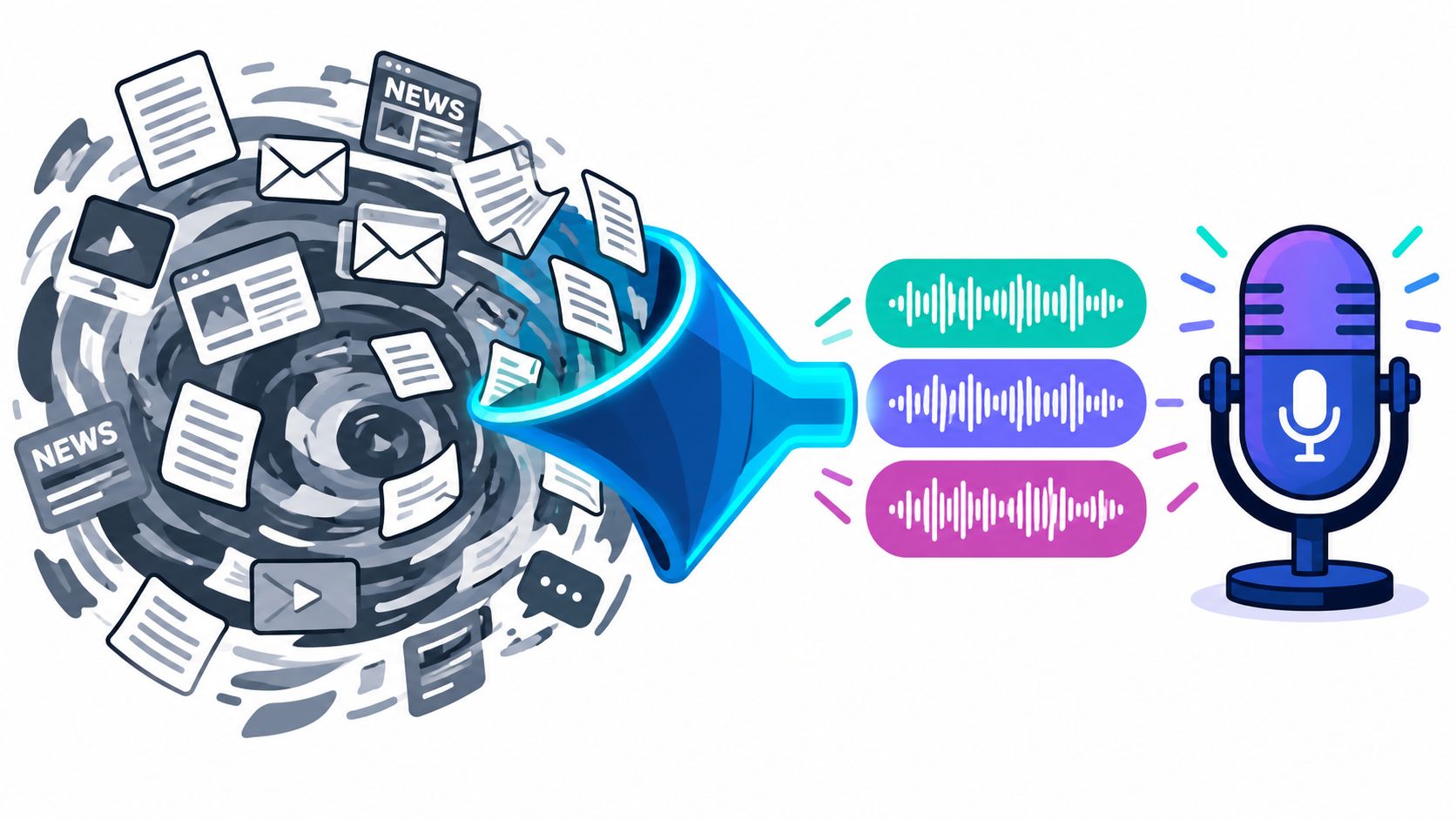
An audio digest app uses AI to convert articles, PDFs, newsletters, or web sources into short, personalized podcast-style episodes you can listen to hands-free. The format fits an already established habit: 41% of consumers across 49 global markets listen to podcasts for at least one hour per week, while 9% listen for more than 10 hours (YouGov's 2025 podcast survey).
You probably know the feeling. Your inbox contains unread newsletters, your browser has too many open tabs, and a report you saved last week is still waiting for your attention. You want the information, but finding quiet time to read it all feels impossible.
An audio digest app changes the format rather than asking you to create more time. It gathers selected sources, condenses them, and delivers the result as a spoken episode for a commute, walk, workout, or household chore. The important question isn't whether the voice sounds realistic. It's whether the app captured the right information, preserved the meaning, and delivered it when your attention was available.
At 7:30 in the morning, your reading queue can already feel like a second job. Three newsletters are waiting, several articles are bookmarked, and a PDF report sits unopened beside a calendar full of meetings. You might promise yourself that you'll catch up at lunch, but the day keeps adding new information faster than you can process it.
An audio digest app gives that queue a shape. Instead of opening every source, you can receive a focused briefing that selects the most relevant material and turns it into a short listening session. On a commute, that could mean hearing the main ideas from industry updates while your phone stays in your pocket.
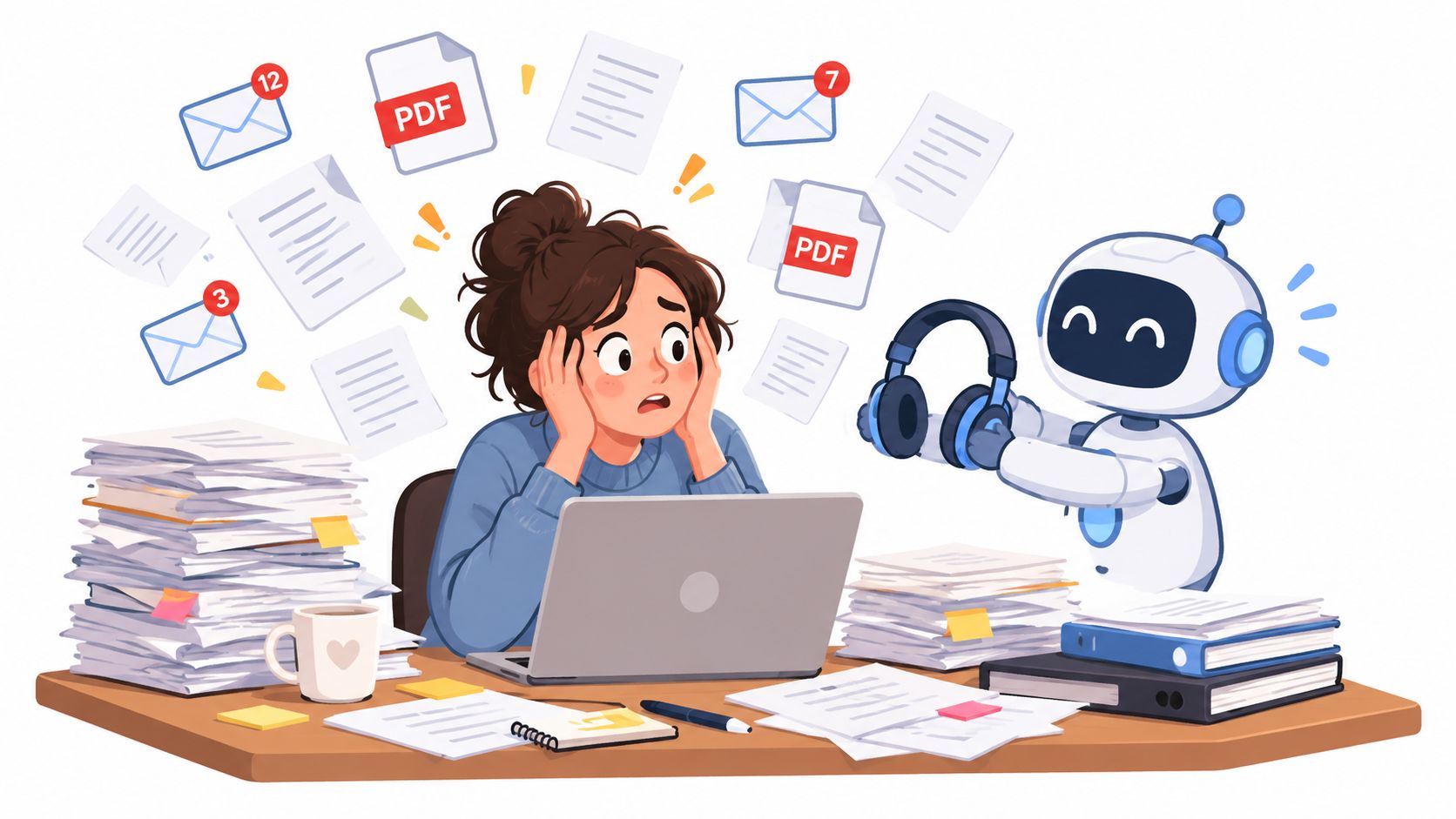
The transformation is useful because it removes several small decisions. You don't have to decide which article to open first, skim every headline, or switch between a newsletter, a browser tab, and a PDF reader. The app creates a listening path from the material you already care about.
A daily episode might combine a few saved web pages, a newsletter, and notes from a meeting. The output shouldn't feel like someone is reading those sources aloud. It should feel like a clear briefing, with connected ideas, useful context, and enough explanation to stand on its own.
Practical rule: Use an audio digest for discovery and orientation, then return to the original source when a detail affects an important decision.
This distinction matters for students, professionals, and curious learners. The format helps you make better use of low-attention moments, but it doesn't make every source equally easy to understand. A dense technical paper and a short news article require different levels of explanation, pacing, and verification.
The strongest products therefore reduce information overload and cognitive load together. They don't merely make more content audible. They help you decide what deserves your focused reading later.
An audio digest app usually works through a three-stage production pipeline. Think of it as a small digital team: one worker captures the material, another edits it into a script, and a third performs the final version.
The first stage is text ingestion or automatic speech recognition, depending on the input. For a web article, the app extracts the written content. For a video or podcast, ASR converts spoken language into a transcript. PDFs, typed notes, newsletters, and other files follow their own extraction paths before the system can analyze them.
Transcription errors matter because the next stage depends on the captured text. A missed name, negation, measurement, or technical term can change the meaning before summarization even begins. Anyone working with recorded material can learn more about this conversion step through the iScribe Live Transcribe guide.
The summarization engine then creates a shorter script. Extractive summarization selects important passages from the source, while abstractive summarization writes a new version that combines and rephrases ideas.
Suppose you add a long report about a changing industry. A useful digest might identify the central development, explain why it matters, mention the supporting evidence, and flag limitations. A weak one might repeat the introduction, omit a qualification, and produce a confident conclusion that the report never made.
Research on a podcast audio-summarization system used this transcript-first architecture and reported ROUGE-1, ROUGE-2, and ROUGE-L F-scores of 0.63, 0.53, and 0.63 for its summarization component (the TREC system paper). Those results illustrate why compression can preserve substantial content, but they don't mean every generated digest is reliable for every purpose.
Finally, text-to-speech turns the script into audio. The voice needs natural pacing, pronunciation, pauses, and emphasis, but vocal realism can't repair a faulty source transcript or a distorted summary.
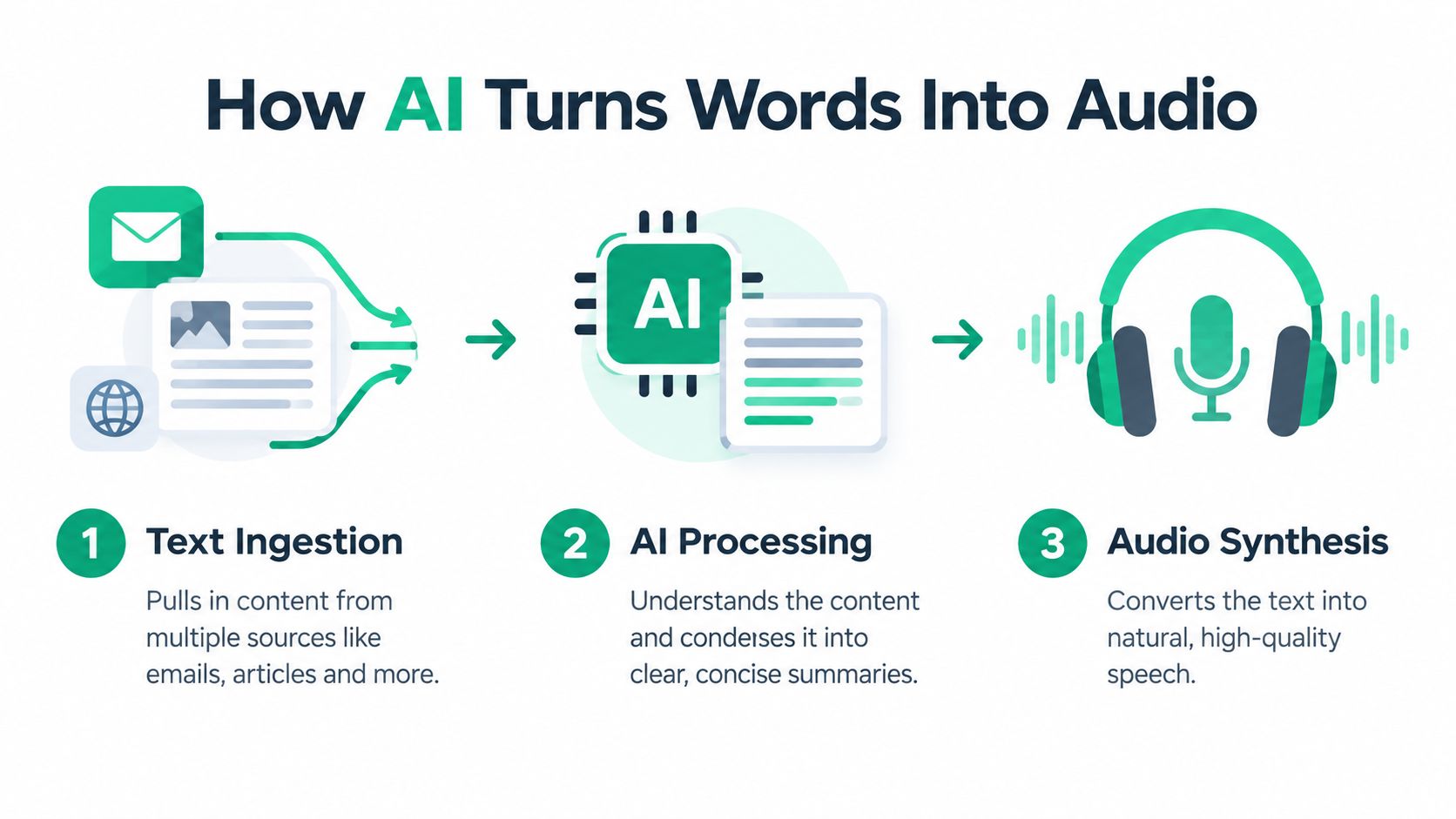
A practical way to understand the workflow is to compare it with turning text into a podcast. You provide material, the system creates a script, and synthetic voices perform it. The quality check must begin before the performance, with questions about what the app included, what it left out, and whether the finished episode remains understandable without the original document.
Podcast evaluation research emphasizes that short outputs should remain grammatical, coherent, readable, and self-contained, rather than merely achieving a high compression ratio (the RANLP podcast summarization study). That's the central lesson: upstream accuracy is usually the bottleneck.
A polished voice can make an app pleasant to use, but pleasant isn't the same as useful. The strongest audio digest apps connect five capabilities into one listening habit.
A good app doesn't turn every new item into an episode. It filters sources according to your topics, subscriptions, freshness preferences, and stated priorities. That keeps the feed from becoming another noisy inbox.
Personalization should affect more than a topic list. You may prefer concise headlines in the morning, deeper explanations on weekends, or a conversational tone for casual learning. Likes, skips, and direct feedback give the system signals about those choices.
A digest becomes easier to sustain when it arrives at a predictable time. Look for controls that let you choose the cadence, episode length, and delivery method. A daily briefing suits a fast-moving topic, while a less frequent series may work better for research or study material.
The app should handle the material you use, not just one ideal input. Useful support may include web pages, PDFs, newsletters, notes, videos, and private feeds. Without that range, you'll keep copying information between separate tools.
A feedback loop closes the distance between what you say you want and what you listen to. If you repeatedly skip long market updates but finish short explainers, the app should learn from that behavior.
These features reinforce one another:
| Capability | The problem it solves |
|---|---|
| Curation | Too many possible sources |
| Personalization | Generic content that doesn't fit you |
| Scheduling | Irregular listening |
| Format flexibility | Fragmented inputs |
| Feedback | Repeatedly irrelevant recommendations |
Without this combination, an app may be little more than a text-to-speech reader. The intelligence lies in deciding what deserves attention, how much context to preserve, and when the result should reach you.
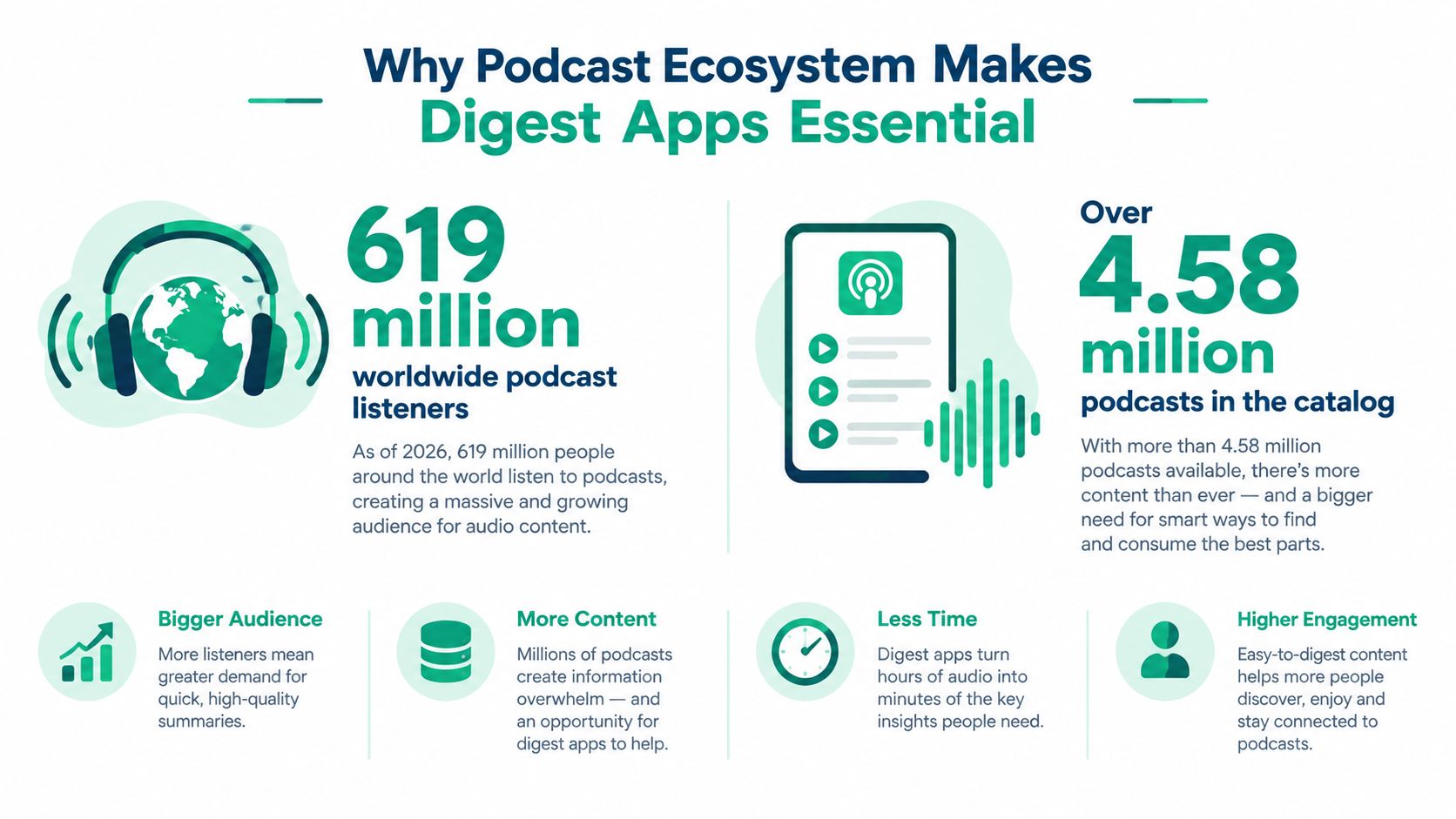
Audio digest apps are growing within a media environment that already has a large, habitual audience. Independent industry reporting places the global podcast audience at about 619 million listeners worldwide in 2026, with a catalog of roughly 4.58 million podcasts available as of January 2026 (podcast industry statistics from AMW Group).
That scale creates a practical problem. More shows mean more expertise, perspectives, and useful material, but they also make discovery harder. A listener interested in one subject can face dozens of programs, long episodes, irregular publishing schedules, and overlapping coverage.
The app's role isn't necessarily to replace podcasts. It can act as a personal filter around them. Instead of browsing a huge catalog, you can define the sources and subjects that matter, then receive a smaller, recurring selection.
Podcast listening depth supports that model. In the same YouGov survey covering 49 global markets, 41% of consumers said they listen for at least one hour per week, and 9% said they listen for more than 10 hours per week. People already understand spoken-word audio as a regular media format, so an individualized digest can fit an existing behavior rather than demanding an entirely new one.
A private feed can make the experience feel familiar. For readers who want more control over distribution, a guide to private podcast RSS feeds explains how selected audio can reach a podcast player without becoming a public show.
The market context also points toward recurring personalization. Industry commentary places the personalized podcast market at $2.84 billion in 2025 and $3.48 billion in 2026, representing a 22.3% CAGR (Research and Markets coverage). That growth signals interest, but it doesn't prove that every app solves the same problem well.
The more useful conclusion is narrower: when content volume rises, filtering becomes part of listening. A digest app earns its place when it reduces the work required to find, select, and follow worthwhile material.
The right audio digest depends on what your attention is doing while you listen. A commuter, a student, and a newsletter curator may all want summarized audio, but they don't need the same output.
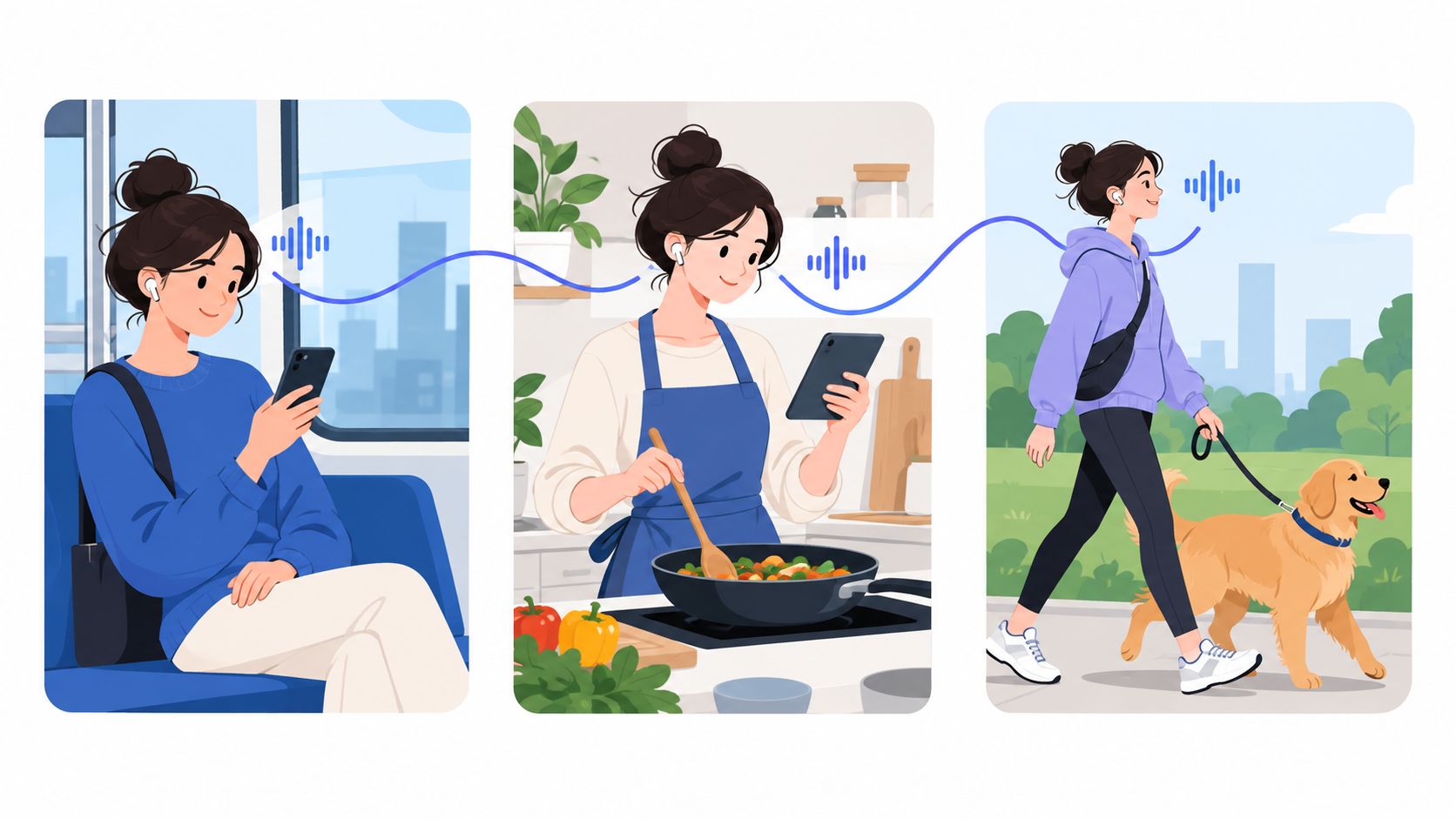
A commuter usually needs a compact, current briefing that works without a screen. The app should lead with what changed, explain why it matters, and avoid burying the main point beneath background detail.
This format works well for industry monitoring, morning headlines, or a quick scan of selected websites. It should also tolerate divided attention. If you miss one sentence while crossing a street or boarding a train, the next segment should still make sense.
A student needs more than compression. Lecture notes and textbook PDFs may need a sequence of connected episodes, definitions, examples, and occasional repetition. A study-oriented app should preserve relationships between concepts instead of treating every source as an isolated summary.
The listening environment matters too. A walk can support review, but difficult material may require a later return to the document. Treat the audio as a structured revision layer, not an automatic substitute for close reading.
A curator or busy professional may want several newsletters combined into one coherent episode. Here, the challenge is synthesis. The app should identify overlapping themes, distinguish separate opinions, and make the origin of each important point clear.
| Listening goal | Best output style | Main evaluation question |
|---|---|---|
| Commuting | Short briefing | Can you follow it with divided attention? |
| Studying | Sequenced lessons | Does it preserve connections between ideas? |
| Monitoring newsletters | Multi-source synthesis | Can you trace important claims back to sources? |
The same feature can help one listener and frustrate another. Adjustable length, pacing, and depth matter because cognitive load changes with the setting. Choose the use case first, then judge the feature list against it.
Automation makes information easier to consume, but it also creates a new question: how do you know the digest stayed faithful to the source?
An AI system can shorten a technical paper while dropping an important limitation. It can combine several updates while blurring which source supports which claim. Translation can make a passage sound fluent while losing a qualification or culturally specific meaning. A realistic voice may make all of those errors feel more authoritative than they should.
For low-stakes discovery, a concise summary may be enough to decide whether a source deserves attention. For exams, professional monitoring, regulatory updates, medical education, or competitive intelligence, you need stronger safeguards.
Look for features that expose the path from output to source:
Current market coverage highlights personalization, multilingual translation, real-time curation, and interactive audio, but those capabilities raise the importance of provenance and source tracing (Research and Markets' personalized podcast platform overview). More automation means more convenience, but it can also make mistakes harder to notice.
A digest should reduce the effort of finding context, not remove your ability to check it.
Before trusting an app, test it with a source whose meaning you already understand. Compare the generated episode with the original, especially around caveats, numbers, names, and conclusions. If the output sounds polished but repeatedly oversimplifies, the voice quality is masking the wrong problem.
Choosing an audio digest app gets easier when you test it against your real reading queue instead of comparing feature badges. Three criteria reveal whether the product fits your habits.
List the material you want to hear each week. Does it include web pages, PDFs, newsletters, notes, videos, or private sources? An app that accepts only one format may look capable during a demo but fail as soon as your workflow becomes mixed.
Try a representative sample. Include a short article, a dense document, and a source with headings or technical terminology. You'll learn more from that test than from a generic claim about broad compatibility.
Multilingual support has two separate parts: writing and narration. A system may translate text directly and then read it aloud, or it may generate a native-sounding script designed for the target language. Listen for terminology, sentence rhythm, names, and whether the explanation still feels natural.
For a broader comparison of transcription tools before you test an audio workflow, the best voice to text converters in 2026 can help clarify how different systems handle captured speech. Remember that good transcription is only the first checkpoint. The summary still needs to preserve meaning.
Decide when listening will happen. A short morning episode, an occasional deep dive, and a structured study series demand different controls. Look for adjustable frequency, episode length, delivery time, downloads, and private-feed support.
A simple decision process can keep you focused:
For learners who want to connect spoken material with a broader study routine, an audio learning app can provide useful ideas about pacing and review. One option, Rooy Development, turns websites, PDFs, notes, and YouTube channels into personalized podcast episodes, with scheduled delivery, private feeds, and multilingual generation in 40+ languages. Evaluate it by the same standards as any other tool, especially source fidelity and use-case fit.
The strongest case for an audio digest app isn't that it creates more content. It's that it places useful content inside routines you already have.
U.S. listeners already spend nearly four hours a day with audio, yet news represents only a small share of daily listening, rising from 2.7% to 2.9% in the first quarter of 2026 (Nielsen's Q1 2026 audio listening report). That pattern suggests an opportunity beyond shortening articles. A digest has to fit the moment, whether that's a drive, a workout, cooking, or another task that leaves your hands occupied.
A useful episode should make modest demands on working memory. It can state the topic early, group related points, explain unfamiliar terms, and signal when one source ends and another begins. It should also make follow-up easy, because passive listening isn't ideal for every kind of understanding.
Connected cars and smart-home devices may make delivery more convenient, but convenience alone won't establish trust. Future systems will need stronger source trails, better multilingual nuance, and controls that let listeners choose between a quick orientation and a fuller explanation.
The central shift is from feature collecting to cognitive-load management. Ask whether the app helps you understand what matters without forcing you to open another screen, remember a confusing sequence, or accept an unsupported conclusion.
An audio digest app is most valuable when it turns scattered information into a manageable next step. Use it to discover, review, and stay current, then give your full attention to the sources that deserve deeper study.
Rooy Development offers a way to turn websites, PDFs, notes, and YouTube channels into scheduled, personalized podcast episodes delivered as MP3 files or through a private feed. If you want to test a hands-free briefing or study series with your own sources, visit Rooy Development and build a listening workflow around your daily routine.
Transform your content into engaging podcasts in seconds with our AI-powered platform.
Get Started Now